
Arithmetic Sequence (nth term & sum)
Each term adds a constant common difference d to the previous term. The closed-form nth-term formula avoids walking through every prior term, and the sum formula collapses the full series into one multiplication.
aₙ = a₁ + (n − 1)·d | Sₙ = n/2 · (2a₁ + (n − 1)·d)
Geometric Sequence (nth term & sum)
Each term multiplies the previous term by a constant common ratio r. The sum formula uses (r − 1) in the denominator and reduces to Sₙ = n·a₁ in the special case r = 1.
aₙ = a₁ · r^(n − 1) | Sₙ = a₁ · (r^n − 1) / (r − 1)
Arithmetic — Find Term Index
Given a known target value aₙ on an arithmetic sequence, solve for the integer position n. The calculator reports that no integer n exists when the target does not land exactly on the sequence (non-integer offset).
n = (aₙ − a₁) / d + 1
Geometric Infinite Sum
When the common ratio satisfies |r| < 1, the infinite geometric series converges to a finite total. The calculator surfaces a divergence warning whenever |r| ≥ 1, where the sum is undefined.
S∞ = a₁ / (1 − r), |r| < 1
How It Works
A sequence is just an ordered list of numbers built by a rule. In an arithmetic sequence the rule is 'add a constant d' so the terms walk up (or down) in even steps. In a geometric sequence the rule is 'multiply by a constant r' so the terms grow or shrink exponentially. The calculator uses the closed-form nth-term and sum formulas so you don't need to expand the series by hand — that way a₁₀₀ is one substitution, not 99 additions or 99 multiplications.
Example Problem
Find the 10th term and the sum of the first 10 terms of the arithmetic sequence starting at 3 with a common difference of 5.
- Identify the parameters: first term a₁ = 3, common difference d = 5, number of terms n = 10.
- Use the closed-form nth-term formula aₙ = a₁ + (n − 1) · d so you can jump straight to the 10th term without listing all of them.
- Substitute the values: a₁₀ = 3 + (10 − 1) · 5 = 3 + 9 · 5 = 3 + 45.
- Simplify: a₁₀ = 48. So the 10th term of the sequence 3, 8, 13, 18, 23, 28, 33, 38, 43, 48 is 48.
- Use the sum formula Sₙ = n/2 · (a₁ + aₙ) — a tidy rearrangement of n/2 · (2a₁ + (n − 1)·d).
- Substitute: S₁₀ = 10/2 · (3 + 48) = 5 · 51 = 255. So the first ten terms sum to 255.
The same closed-form pattern scales: a₁₀₀ = 3 + 99·5 = 498 with no extra effort.
Key Concepts
The common difference d controls an arithmetic sequence — positive d climbs, negative d descends, and d = 0 produces a constant sequence. The common ratio r controls a geometric sequence — |r| > 1 grows, |r| < 1 shrinks toward zero, and r < 0 alternates signs. An infinite geometric series converges only when |r| < 1, in which case S∞ = a₁ / (1 − r); otherwise the sum diverges. Different recurrences such as the Fibonacci sequence (aₙ = aₙ₋₁ + aₙ₋₂) are neither arithmetic nor geometric — they need their own closed forms. Two other handy means: the arithmetic mean of a and b is (a + b)/2 and the geometric mean is √(a·b); they coincide only when a = b.
Applications
- Compound interest: balances under a fixed periodic rate form a geometric sequence with r = 1 + i
- Savings annuities: equal periodic deposits build a geometric-style accumulation and the sinking-fund formula is its inverse
- Exponential growth and decay: population counts, radioactive samples, and drug clearance after each half-life
- Fractal generation: each iteration multiplies count or scale by a fixed ratio (Koch curve, Sierpinski triangle)
- Financial planning: laddered CD maturities and step-up bond coupons form arithmetic progressions of cash flows
Common Mistakes
- Using the arithmetic formula on a geometric sequence (or vice versa) — check whether each step adds a constant d (arithmetic) or multiplies by a constant r (geometric)
- Off-by-one on the term index — the first term is n = 1, not n = 0, so the formula uses (n − 1) inside the exponent or step
- Assuming every infinite geometric series converges — only |r| < 1 produces a finite sum; |r| ≥ 1 diverges
- Forgetting the r = 1 special case for geometric sums — the (r − 1) denominator would divide by zero, so the formula becomes Sₙ = n · a₁
Frequently Asked Questions
What is an arithmetic sequence?
An arithmetic sequence is a list of numbers where each term is obtained by adding a fixed value, called the common difference d, to the previous term. For example, 3, 8, 13, 18 is arithmetic with d = 5. The nth term is aₙ = a₁ + (n − 1)·d.
What is a geometric sequence?
A geometric sequence is a list of numbers where each term is obtained by multiplying the previous term by a fixed value, called the common ratio r. For example, 2, 6, 18, 54 is geometric with r = 3. The nth term is aₙ = a₁ · r^(n − 1).
How do you find the nth term of a sequence?
For an arithmetic sequence use aₙ = a₁ + (n − 1)·d. For a geometric sequence use aₙ = a₁ · r^(n − 1). These closed-form formulas let you jump straight to any term without listing all the earlier ones — useful when n is large.
How do you find the sum of an arithmetic sequence?
Use Sₙ = n/2 · (a₁ + aₙ), which is equivalent to Sₙ = n/2 · (2a₁ + (n − 1)·d). It pairs the first and last terms (which always add to the same total), multiplies by half the number of terms, and gives the total in one step.
What is the formula for a geometric series?
For a finite geometric series with r ≠ 1, Sₙ = a₁ · (r^n − 1) / (r − 1). For the special case r = 1, every term equals a₁ and the sum is simply n · a₁. For an infinite geometric series with |r| < 1, S∞ = a₁ / (1 − r).
When does a geometric series converge?
An infinite geometric series a₁ + a₁·r + a₁·r² + … converges to a finite total only when |r| < 1. If |r| ≥ 1 the terms do not shrink toward zero and the partial sums grow without bound (or oscillate when r is negative), so the series diverges and has no finite sum.
What is the difference between arithmetic and geometric sequences?
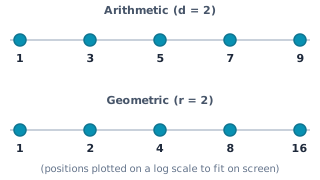
An arithmetic sequence adds the same step d to move from one term to the next, producing linear growth or decay. A geometric sequence multiplies by the same ratio r, producing exponential growth or decay. Plotting them on the same axis, arithmetic terms are evenly spaced while geometric terms get further and further apart (or closer and closer together) as you move along the sequence.
Is the Fibonacci sequence arithmetic or geometric?
Neither. The Fibonacci sequence is defined by aₙ = aₙ₋₁ + aₙ₋₂, which is a second-order linear recurrence rather than an arithmetic or geometric progression. Its ratio of consecutive terms approaches the golden ratio (~1.618) but is not constant for finite n.
Reference:
Standard definitions and closed-form expressions for arithmetic and geometric sequences from discrete mathematics. Round-trip canonical cases: arithmetic a₁=3, d=5, n=10 → a₁₀=48, S₁₀=255; geometric a₁=2, r=3, n=6 → a₆=486, S₆=728; infinite geometric a₁=1, r=0.5 → S∞ = 2.
Arithmetic vs Geometric at a Glance
Side-by-side, the two sequence types are easy to tell apart by spacing: arithmetic terms march in equal steps while geometric terms accelerate (or compress) by a fixed multiplicative ratio.
Worked Examples
Arithmetic Sequence
Find a₁₀ and S₁₀ of the sequence starting at 3 with common difference 5.
- aₙ = a₁ + (n − 1)·d = 3 + 9·5 = 48
- Sₙ = n/2 · (a₁ + aₙ) = 10/2 · (3 + 48) = 5 · 51 = 255
- Sequence: 3, 8, 13, 18, 23, 28, 33, 38, 43, 48
Geometric Sequence
Find a₆ and S₆ of the sequence starting at 2 with common ratio 3.
- aₙ = a₁ · r^(n − 1) = 2 · 3⁵ = 2 · 243 = 486
- Sₙ = a₁ · (r^n − 1) / (r − 1) = 2 · (729 − 1) / 2 = 728
- Sequence: 2, 6, 18, 54, 162, 486
Infinite Geometric Sum
Sum the infinite geometric series 1 + 0.5 + 0.25 + 0.125 + … .
- Common ratio r = 0.5, so |r| < 1 and the series converges.
- S∞ = a₁ / (1 − r) = 1 / (1 − 0.5) = 1 / 0.5 = 2.
- The partial sums approach 2 but never exceed it.
Related Calculators
- Factorial Calculator — compute n! with full step-by-step expansion
- Sinking Fund Calculator — periodic deposit needed to hit a future target (geometric-sum inverse)
- Future Value Calculator — F = P(1 + i)^n — compound growth as a geometric sequence
- Linear Interpolation Calculator — estimate y between two known points on a straight line
- Statistics Calculator — mean, median, standard deviation, and variance
Related Sites
- Z-Score Calculator — Z-score, percentile, and probability calculator
- Percent Error Calculator — Calculate percent error between experimental and theoretical values
- Medical Equations — Hemodynamic, pulmonary, and dosing calculators
- OptionsMath — Options trading profit and loss calculators
- LoanChop — Loan prepayment calculator
- Temperature Tool — Temperature unit converter