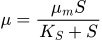
Specific Growth Rate (Monod Equation)
The Monod equation models how fast microorganisms grow as a function of substrate concentration. When substrate is abundant, growth approaches the maximum rate μ_m. When substrate drops near K_s, growth slows to half its maximum.
μ = μ_m × S / (K_s + S)
Maximum Growth Rate
Solve for the maximum specific growth rate when you know the current growth rate, substrate concentration, and half-saturation constant.
μ_m = μ × (K_s + S) / S
Substrate Concentration
Determine the substrate concentration from the observed growth rate, maximum rate, and saturation constant. Useful for monitoring biological treatment systems.
S = μ × K_s / (μ_m − μ)
Half-Saturation Constant
Find the half-saturation constant K_s, which is the substrate concentration at which growth occurs at half its maximum rate. Lower K_s means more efficient substrate scavenging.
K_s = S × (μ_m − μ) / μ
How It Works
The Monod equation models how fast microorganisms grow as a function of substrate (food) concentration. When substrate is abundant, growth approaches a maximum rate μ_m. When substrate drops near the half-saturation constant K_s, growth slows to half its maximum. This relationship is central to designing activated sludge systems, biofilters, and anaerobic digesters. The equation mirrors Michaelis-Menten enzyme kinetics and is written as μ = μ_m × S / (K_s + S).
Example Problem
A bacterial culture in an aeration basin has a maximum growth rate μ_m = 0.5 s⁻¹, half-saturation constant K_s = 0.02 kg/m³, and the current substrate concentration is 0.08 kg/m³. Find the specific growth rate.
- Identify the known values: μ_m = 0.5 s⁻¹, K_s = 0.02 kg/m³, and S = 0.08 kg/m³.
- Determine what we are solving for: the specific growth rate μ using the Monod equation.
- Write the Monod equation: μ = μ_m × S / (K_s + S).
- Substitute the values: μ = 0.5 × 0.08 / (0.02 + 0.08).
- Multiply: 0.5 × 0.08 = 0.04. Add: 0.02 + 0.08 = 0.10.
- Divide: μ = 0.04 / 0.10 = 0.4 s⁻¹. At 80% of maximum, the culture is substrate-rich but approaching saturation.
At 80% of the maximum rate, the culture is substrate-rich but approaching saturation.
When to Use Each Variable
- Solve for Growth Rate — when you know maximum rate, substrate concentration, and K_s and want the actual growth rate.
- Solve for Max Growth Rate — when you have measured growth rate and substrate data and want to characterize the organism's maximum potential.
- Solve for Substrate Concentration — when monitoring a bioreactor and want to estimate the remaining substrate from growth rate data.
- Solve for K_s — when calibrating a Monod model from experimental growth and substrate measurements.
Key Concepts
The Monod equation models microbial growth as a saturable function of substrate concentration, analogous to Michaelis-Menten enzyme kinetics. At low substrate levels, growth is approximately first-order (proportional to substrate). At high substrate levels, growth saturates and becomes zero-order (independent of substrate). The half-saturation constant K_s indicates an organism's affinity for substrate — lower K_s means the organism can grow efficiently even at very low concentrations.
Applications
- Activated sludge design: sizing aeration basins and determining solids retention time for wastewater treatment
- Biofilm reactors: modeling substrate removal rates in trickling filters and rotating biological contactors
- Anaerobic digestion: predicting methane production rates based on organic loading and microbial kinetics
- Bioremediation: estimating contaminant degradation rates in soil and groundwater treatment systems
Common Mistakes
- Using Monod kinetics outside the growth phase — the equation does not account for lag phase, endogenous decay, or toxic inhibition
- Assuming K_s is constant across conditions — temperature, pH, and the presence of inhibitors all affect the apparent half-saturation constant
- Confusing specific growth rate with substrate removal rate — the two are related by the yield coefficient (Y), which must be included for mass balance calculations
Frequently Asked Questions
What controls the growth rate of bacteria in a bioreactor?
The growth rate is primarily controlled by the substrate (food) concentration relative to the half-saturation constant Ks. When substrate is abundant (S >> Ks), growth approaches the maximum rate μm. Temperature, dissolved oxygen, pH, and the presence of inhibitors also affect growth, but the Monod equation focuses on substrate limitation as the dominant factor.
What is the Monod equation and when does it apply?
The Monod equation (μ = μm × S / (Ks + S)) describes substrate-limited microbial growth. It applies during the exponential growth phase in bioreactors, activated sludge systems, and fermenters. It does not account for lag phase, endogenous decay, toxic inhibition, or multiple substrate limitations.
What is the Monod equation used for?
The Monod equation predicts microbial growth rates in biological treatment systems. Engineers use it to size aeration basins, determine sludge retention times, and model substrate removal in activated sludge and biofilm processes.
What does the half-saturation constant Ks represent?
K_s is the substrate concentration at which growth occurs at half its maximum rate. A low K_s (e.g., 0.01 kg/m³) means the organism is very efficient at scavenging low-level substrate. Typical values for domestic wastewater bacteria range from 0.01 to 0.18 kg/m³.
How is Monod kinetics different from first-order kinetics?
At very low substrate concentrations (S much less than K_s), Monod kinetics approximates first-order behavior. At high concentrations (S much greater than K_s), growth becomes zero-order and independent of substrate. First-order models miss this saturation effect.
Can the Monod equation predict decay phase behavior?
No. The Monod equation only models growth-phase kinetics. For decay, engineers add an endogenous respiration term: net growth = μ − kd, where kd is the decay coefficient. This extension is used in activated sludge design to account for biomass loss during low-substrate periods.
How do you experimentally determine Monod parameters?
Run batch or chemostat experiments at several dilution rates, measuring both substrate concentration and biomass at steady state. Plot 1/μ vs 1/S (Lineweaver-Burk) or μ vs S directly and fit the Monod curve. Modern software uses nonlinear regression for more accurate parameter estimates than linearized methods.
Monod Equation
The Monod equation describes the relationship between microbial growth rate and substrate concentration:
μ = μm × S / (Ks + S)
Where:
- μ — specific growth rate (s⁻¹ or hr⁻¹)
- μm — maximum specific growth rate, the ceiling when substrate is unlimited
- S — substrate (food) concentration (kg/m³ or mg/L)
- Ks — half-saturation constant, the substrate concentration at which growth = μm/2
The equation mirrors Michaelis-Menten enzyme kinetics and is the foundation for designing activated sludge processes, biofilm reactors, and fermentation systems.
Worked Examples
Bioreactor Design (Fermentation)
At what rate will E. coli grow in a glucose-fed bioreactor?
A bioreactor has μm = 0.8 s⁻¹, Ks = 0.005 kg/m³, and current glucose concentration S = 0.02 kg/m ³.
- μ = 0.8 × 0.02 / (0.005 + 0.02)
- μ = 0.016 / 0.025
μ = 0.64 s⁻¹
At 80% of maximum rate, the culture is substrate-rich. The reactor is operating efficiently near saturation.
Wastewater Treatment
What substrate concentration keeps growth at 60% of maximum in an aeration basin?
An activated sludge system has μm = 0.5 s⁻¹ and Ks = 0.015 kg/m³. The target growth rate is 0.3 s ⁻¹.
- S = μ × Ks / (μm − μ)
- S = 0.3 × 0.015 / (0.5 − 0.3)
S = 0.0225 kg/m³
Maintaining at least 22.5 mg/L BOD in the mixed liquor ensures the biomass stays productive without excessive aeration costs.
Pharmaceutical (Antibiotic Production)
What is the maximum growth rate of a Streptomyces culture?
Lab measurements show μ = 0.12 s⁻¹ at S = 0.03 kg/m³ with Ks = 0.01 kg/m³.
- μm = μ × (Ks + S) / S
- μm = 0.12 × (0.01 + 0.03) / 0.03
μm = 0.16 s⁻¹
Knowing μm helps size the fed-batch fermentation to maximize antibiotic yield without overfeeding substrate.
Related Calculators
- Microorganism Disinfection Calculator — calculate the CT value needed to inactivate pathogens
- Activated Sludge Calculator — evaluate biological reactor performance via SVI
- Biochemical Oxygen Demand Calculator — quantify organic loading for biological systems
- Ideal Reactor Calculator — determine reactor volume and detention time for biological treatment
- Flocculation Calculator — calculate velocity gradient for particle aggregation in water treatment
- Volume Unit Converter — convert between liters, gallons, and cubic meters for reactor sizing
Related Sites
- CameraDOF — Depth of field calculator for photographers
- Medical Equations — Hemodynamic, pulmonary, and dosing calculators
- Hourly Salaries — Hourly wage to annual salary converter
- RN Calc — Nursing dosage and calculation tools
- InfantChart — Baby and child growth percentile charts
- Z-Score Calculator — Z-score, percentile, and probability calculator