Sludge Volume Index
The Sludge Volume Index measures how well activated sludge settles in a clarifier. A lower SVI means denser, faster-settling sludge and a healthier treatment process. Well-settling sludge typically falls between 50–150 mL/g.
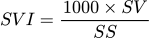
SVI = 1000 × SV / SS
How It Works
The Sludge Volume Index measures how well activated sludge settles in a clarifier. You let a mixed-liquor sample settle for 30 minutes, record the volume it occupies, then divide by the suspended solids concentration. A lower SVI means denser, faster-settling sludge and a healthier treatment process. The formula is SVI = 1000 × SV / SS, where SV is settling volume (mL/L) and SS is suspended solids (mg/L). Well-settling sludge typically falls between 50–150 mL/g.
Example Problem
A 1-liter sample of mixed liquor from a municipal treatment plant settles to 250 mL after 30 minutes. The lab reports an MLSS concentration of 2,500 mg/L. Determine whether the sludge is settling properly.
- Identify the known values: settled volume SV = 250 mL/L and suspended solids SS = 2,500 mg/L from the lab report.
- Determine what we are solving for: the Sludge Volume Index (SVI) to assess settling quality.
- Write the SVI equation: SVI = 1000 × SV / SS.
- Substitute the values: SVI = 1000 × 250 / 2,500.
- Multiply: 1000 × 250 = 250,000.
- Divide: SVI = 250,000 / 2,500 = 100 mL/g. This falls within the 50–150 mL/g range, indicating healthy settling sludge.
An SVI of 100 mL/g indicates good settling characteristics — the sludge is neither bulking nor excessively dense.
When to Use Each Variable
- Solve for SVI — when you have the settling volume and suspended solids concentration from a 30-minute settleability test, e.g., daily monitoring of activated sludge health.
- Solve for Settling Volume — when you know the target SVI and MLSS concentration, e.g., predicting expected settled volume for a given sludge condition.
- Solve for Suspended Solids — when you know the SVI and settling volume and need to determine the MLSS concentration, e.g., back-calculating solids from a settleability test.
Key Concepts
The Sludge Volume Index relates the physical settleability of activated sludge to its suspended solids concentration. SVI below 100 mL/g typically indicates compact, well-flocculated sludge, while SVI above 150 mL/g suggests filamentous bulking that impairs clarifier performance. The test uses a standard 1-liter graduated cylinder and exactly 30 minutes of undisturbed settling.
Applications
- Wastewater treatment plants: daily process control monitoring to detect bulking sludge early
- Industrial pretreatment: evaluating settleability of biological treatment systems for food processing waste
- Environmental compliance: demonstrating adequate sludge quality to meet NPDES discharge permit requirements
- Process optimization: adjusting return activated sludge (RAS) rates based on SVI trends
Common Mistakes
- Using a sample that was not well-mixed before pouring into the graduated cylinder — poor mixing gives an unrepresentative settling volume
- Reading the settled volume before exactly 30 minutes — early readings underestimate SVI, late readings overestimate it due to compression settling
- Applying standard SVI at very high MLSS concentrations (above 4,000 mg/L) — at high solids, use the Diluted SVI (DSVI) to avoid compression artifacts
Frequently Asked Questions
How does the activated sludge process remove pollutants from wastewater?
The activated sludge process uses aerobic microorganisms suspended in mixed liquor to consume dissolved organic matter. Air is pumped into an aeration basin to keep the biomass active. The microorganisms metabolize BOD, nitrogen, and phosphorus, converting them into cell mass and gases. The treated water then flows to a secondary clarifier where the biomass settles and is recycled back to the basin.
What is the typical sludge age for a municipal treatment plant?
Municipal treatment plants typically maintain a sludge age (solids retention time) of 5 to 15 days for conventional activated sludge. Extended aeration systems use 20 to 30 days. Shorter sludge ages favor fast-growing organisms but risk poor settling, while longer ages improve nitrification but increase oxygen demand.
What is a good sludge volume index?
An SVI between 50 and 150 mL/g generally indicates healthy, well-settling sludge. Values above 150 mL/g suggest bulking sludge that settles poorly, while values below 50 mL/g may point to old, over-oxidized sludge.
What causes high SVI in activated sludge?
High SVI is usually caused by filamentous bacteria that form a loose, fluffy sludge blanket. Low dissolved oxygen, nutrient imbalances, or excessive organic loading can all promote filamentous growth and push SVI above 200 mL/g.
How do you measure settling volume for SVI?
Fill a 1-liter graduated cylinder with well-mixed activated sludge and let it stand undisturbed for exactly 30 minutes. Read the volume of the settled sludge blanket in mL. That reading is your SV value.
What is the difference between SVI and DSVI?
The Diluted SVI (DSVI) corrects for high sludge concentrations by diluting the sample so the settled volume stays below 200 mL/L. This avoids compression effects that make standard SVI unreliable at high MLSS levels.
How does return activated sludge rate affect SVI?
The return activated sludge (RAS) rate controls the MLSS concentration in the aeration basin. Too low a RAS rate can cause solids to build up in the clarifier, leading to denitrification and rising sludge. Too high a RAS rate dilutes the settled sludge and can increase SVI by reducing settling time in the clarifier.
Sludge Volume Index Formula
The SVI quantifies the settling quality of activated sludge using a simple ratio:
SVI = 1000 × SV / SS
Where:
- SVI -- Sludge Volume Index, in mL/g (dimensionless ratio)
- SV -- settled sludge volume after 30 minutes, in mL/L
- SS -- suspended solids (MLSS) concentration, in mg/L
- 1000 -- conversion factor from mg to g
A lower SVI means denser, faster-settling sludge. Values above 150 mL/g signal filamentous bulking that can overwhelm secondary clarifiers.
Worked Examples
Municipal WWTP
Is a city treatment plant's sludge settling properly?
A 1-liter settled sample reads 300 mL after 30 minutes. The lab reports MLSS of 2,500 mg/L. Calculate SVI to assess sludge health.
- SV = 300 mL/L, SS = 2,500 mg/L
- SVI = 1000 × 300 / 2,500
SVI = 120 mL/g
SVI of 120 is within the 50-150 mL/g healthy range, though trending toward the upper limit. Operators should monitor for early signs of filamentous growth.
Industrial (Food Processing)
What MLSS concentration does a dairy plant need for target SVI?
A dairy processing effluent settles to 350 mL in a 30-minute test. The operator targets an SVI of 100 mL/g. What MLSS concentration is required?
- SS = 1000 × SV / SVI
- SS = 1000 × 350 / 100
SS = 3,500 mg/L
The plant needs to maintain at least 3,500 mg/L MLSS to keep the SVI at 100, ensuring the clarifier can handle the solids loading.
Environmental Compliance
What settling volume indicates compliant sludge quality?
A facility's NPDES permit requires SVI below 150 mL/g. The MLSS is 2,000 mg/L. What is the maximum acceptable settled volume?
- SV = SVI × SS / 1000
- SV = 150 × 2,000 / 1000
SV = 300 mL
If the 30-minute settling test shows more than 300 mL, the sludge is non-compliant. The operator should investigate aeration, RAS rates, and nutrient balance.
Related Calculators
- Biochemical Oxygen Demand Calculator — measure the organic load entering your treatment plant
- Wastewater Screening Calculator — design bar racks and fine screens upstream of the activated sludge process
- Ideal Reactor Calculator — size the aeration basin using residence time and flow rate
- Flocculation Calculator — design flocculation basins for solids removal in treatment trains
- Volume Converter — convert between gallons, liters, cubic meters, and other volume units
Related Sites
- CameraDOF — Depth of field calculator for photographers
- Medical Equations — Hemodynamic, pulmonary, and dosing calculators
- Hourly Salaries — Hourly wage to annual salary converter
- RN Calc — Nursing dosage and calculation tools
- InfantChart — Baby and child growth percentile charts
- Z-Score Calculator — Z-score, percentile, and probability calculator