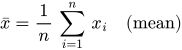
Mean equals the sum of all values divided by the count. Median is the middle value when the data is sorted. Mode is the most frequently occurring value. Range equals the maximum value minus the minimum value.
Summary =
Mean
5
arithmetic average
Median
5
positional middle
Mode
7
most frequent
Range
5
max − min
Count (n)
8
Sum (Σxᵢ)
40
Min
2
Max
7
Show Your Work
Mean = Σxᵢ / n
Mean = (2 + 3 + 4 + 4 + 6 + 7 + 7 + 7) / 8
Mean = 40 / 8 = 5
Sort the data:
2, 3, 4, 4, 6, 7, 7, 7
Average of middle two: (4 + 6) / 2 = 5
Mode = 7
Range = max − min = 7 − 2 = 5
Final answer: mean=5, median=5, mode=7, range=5
Share:
Mean (Arithmetic Average)
Add every value in the data set and divide by the count. The mean is the standard 'average' and is most useful when the distribution is roughly symmetric and free of extreme outliers — outliers pull the mean toward themselves.
mean = Σxᵢ / n
Median (Positional Middle)
Sort the values from low to high and take the one in the middle. With an even count there is no single middle, so average the two middle values. The median is resistant to outliers and is the preferred summary for skewed data like income or home prices.
median = middle value of the sorted data
Mode (Most Frequent Value)
Count how many times each value appears and report whichever is most common. A data set can be unimodal (one mode), bimodal or multimodal (a tie at the top), or have no mode at all when every value is unique.
mode = value(s) that occur most often
Range (Spread)
Subtract the smallest value from the largest. Range is the simplest measure of spread — quick to compute but extremely sensitive to outliers because it depends only on the two most extreme points.
range = max − min
How It Works
Mean, median, mode, and range are the four most common descriptive statistics. The mean (arithmetic average) sums every value and divides by the count — it gives the 'balance point' of the data but is easily skewed by outliers. The median is the value in the middle of the sorted list, so half the data lies above and half below; it is resistant to outliers and is the right summary for skewed distributions. The mode is whichever value appears most often, useful for categorical-style data like shoe sizes or survey responses. Range = max − min reports the total spread in the same units as the data. Together these four numbers give a fast, intuitive snapshot of where a data set is centered and how widely it varies — which is why they are taught before variance, standard deviation, and quartiles in every introductory statistics course.
Example Problem
Find the mean, median, mode, and range of the data set [2, 3, 4, 4, 6, 7, 7, 7].
Sum the values: 2 + 3 + 4 + 4 + 6 + 7 + 7 + 7 = 40, with n = 8.
Mean = Σxᵢ / n = 40 / 8 = 5.
Sort the values: 2, 3, 4, 4, 6, 7, 7, 7. With n = 8 (even), the median is the average of the two middle values, positions 4 and 5: (4 + 6) / 2 = 5.
Count occurrences: 2 → 1, 3 → 1, 4 → 2, 6 → 1, 7 → 3. The value 7 appears most often, so mode = 7.
Range = max − min = 7 − 2 = 5.
Final summary: mean = 5, median = 5, mode = 7, range = 5.
Notice that mean and median agree exactly at 5. When mean and median are equal the distribution is symmetric around the center; when they differ, the gap points toward the skew (mean > median for right-skewed data, mean < median for left-skewed).
Key Concepts
Each of the four statistics tells a different story. The mean is the only one that uses every value's exact magnitude — it 'feels' every outlier — which makes it the right summary for tightly clustered data and the wrong summary for income, home prices, or any long-tailed distribution. The median is positional: it cares only about rank order, not magnitudes, so a single extreme value cannot move it. That makes the median 'resistant' (or 'robust'), while the mean is 'non-resistant'. The mode answers a different question entirely — not 'what's the typical value?' but 'what's the most popular value?' — and is the only one of the four that applies cleanly to categorical data like favorite colors or letter grades. Range is the simplest spread metric and pairs naturally with median for a robust five-number summary, but it ignores everything between the two extremes; variance and standard deviation correct that by using every value's deviation from the mean. When a distribution is perfectly symmetric and unimodal, mean = median = mode — a useful sanity check for clean data. When the three diverge, the gap tells you about skew and multimodality before you even draw the histogram.
Applications
Grade reporting — teachers report class averages (mean) but also the median and mode to detect grade clusters and outliers.
Salary and income statistics — government agencies publish both mean and median household income because the right-skewed distribution makes the median the better 'typical' summary.
Polling and opinion research — the mode identifies the most-chosen response in multiple-choice surveys; the median identifies the central position in ordered scale (Likert) responses.
Demographics — modal age, modal household size, and median age of a population summarize age structure without distortion by extreme cases.
Restaurant and product ratings — the mean star rating is the headline; the mode shows which star count is most common (often 5 for popular items).
Real estate — median home price is reported in nearly every market report because a few luxury sales would inflate the mean and mislead buyers.
Quality control — range is a quick on-the-floor metric (max − min of a small sample) before computing full process standard deviation.
Common Mistakes
Using the mean for skewed data — for income, home prices, response times, or any long-tailed distribution, the median is a more honest 'typical' value because outliers do not pull it.
Treating 'no mode' as 'mode = 0' — when every value is unique, the data set genuinely has no mode. Reporting 0 confuses a numeric value with the absence of a mode.
Forgetting that multimodal data sets exist — if two or more values tie for the highest frequency, all of them are modes. A bimodal distribution often signals two underlying subgroups in the data.
Mistaking range for variance or standard deviation — range = max − min is a single subtraction and ignores every value in between. It is not interchangeable with variance, which weights every deviation from the mean.
Including non-numeric entries in numeric statistics — blank rows, text, and 'N/A' must be excluded (this calculator skips them automatically) before mean, median, or range have any meaning.
Confusing 'average' colloquially with the mean — in everyday speech 'average' usually means the mean, but in statistics the median and mode are also forms of average (the 'three measures of central tendency'). Always specify which one you are reporting.
Frequently Asked Questions
How do you calculate mean, median, and mode?
Mean: add every value and divide by the count (mean = Σxᵢ / n). Median: sort the values and take the middle one — or average the two middle values when the count is even. Mode: count how often each value appears and report whichever is most frequent. If every value is unique there is no mode; if two or more values tie for highest frequency the data is multimodal and every tied value is a mode.
What is the difference between mean and median?
The mean is the arithmetic average — it adds up every value and divides by the count, so it 'feels' every data point. The median is the positional middle of the sorted list — half the values lie above it and half below. The key practical difference is sensitivity to outliers: the mean is pulled toward extreme values, the median is not. For symmetric data the two agree; for skewed data they diverge.
When should I use the median instead of the mean?
Use the median when the data is skewed or contains outliers — income, home prices, web-page response times, hospital lengths of stay, and waiting times all have long right tails where the mean overstates the 'typical' value. The median is also the right choice for ordinal data (rankings, Likert-scale survey responses) where the spacing between values is not meaningful. For symmetric, outlier-free data either the mean or median works.
What is mode in statistics?
The mode is the value (or values) that occurs most frequently in a data set. Unlike mean and median, the mode applies cleanly to categorical data — favorite color, blood type, letter grade — because it only requires counting occurrences, not adding or sorting magnitudes. A data set can be unimodal (one mode), bimodal (two modes), multimodal (three or more), or have no mode at all when every value appears exactly once.
Can a dataset have more than one mode?
Yes. When two or more values tie for the highest frequency, every tied value is a mode and the distribution is called bimodal (two modes) or multimodal (three or more). Bimodal data often signals two underlying subgroups — for example, the height distribution of a mixed-sex population is bimodal because it combines two narrower unimodal distributions for women and men.
What if there is no mode?
When every value in a data set appears exactly once, the convention is to report 'no mode' rather than picking an arbitrary value. Do not enter 0 — that would mislabel the absence of a mode as a real numeric value. Some textbooks instead say 'every value is a mode' in this case; the practical effect is the same: the mode is uninformative and you should use the mean or median to summarize central tendency instead.
What is the range of a dataset?
Range is the simplest measure of spread: range = max − min, the difference between the largest and smallest values. It carries the same units as the original data and is quick to compute, but it only uses two values and is extremely sensitive to outliers. For a richer spread description use the interquartile range (IQR), variance, or standard deviation, which incorporate every value in the data set.
Are mean, median, and mode ever equal?
Yes — when the distribution is perfectly symmetric and unimodal (the textbook example is a normal distribution), the mean, median, and mode all coincide at the same value. Real-world data rarely achieves this exactly, so the three summaries usually differ. The size and direction of the gap is itself diagnostic: mean > median > mode signals right (positive) skew, mean < median < mode signals left (negative) skew.
Reference:
Standard introductory-statistics definitions as used by the NIST/SEMATECH e-Handbook of Statistical Methods, the College Board AP Statistics curriculum, and OpenIntro Statistics. The four measures are the foundation of the descriptive-statistics chapter in every standard textbook.
Mean, Median, Mode & Range Formulas
Four formulas summarize the center and spread of a numeric data set:
mean = Σxᵢ / n
median = middle value of the sorted data
mode = value(s) that occur most often
range = max − min
Where:
xᵢ — each individual value in the data set
n — the count of values in the data set
Σxᵢ — the sum of all values
max, min — the largest and smallest values after sorting
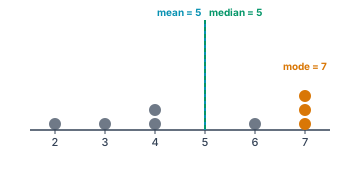
For the dot-plot above of the data set [2, 3, 4, 4, 6, 7, 7, 7], mean and median both land at 5, the mode is 7 (the value that appears three times), and the range is 7 − 2 = 5. When mean and median diverge it points to a skewed distribution; when they agree and there is a single mode at the same value, the data is symmetric.
Worked Examples
Education — Test Score Summary
How do you summarize a class of test scores with mean, median, and mode?
A teacher records ten quiz scores out of 10: 7, 8, 8, 9, 6, 10, 8, 7, 9, 8. Find the mean, median, mode, and range.
All three central-tendency measures agree at 8, and the mode confirms the class clusters around a B-grade score. A small range (4 of 10 points) means the class performed consistently.
Real Estate — Skewed Home Prices
Why is median home price usually reported instead of mean?
Seven recent home sales in a neighborhood (in thousands): 220, 245, 260, 275, 290, 310, 1200. Find the mean and median.
Sum = 2800, n = 7 → mean = 2800 / 7 ≈ 400.
Sorted: 220, 245, 260, 275, 290, 310, 1200. Median (n odd) = middle value = 275.
Mode: every value is unique → no mode.
Range = 1200 − 220 = 980.
Mean ≈ 400, median = 275, no mode, range = 980.
The one luxury sale at $1.2M pulls the mean to $400K — far above the typical $275K home. Real estate sites publish the median because it represents what a 'typical' buyer will actually pay.
Survey Research — Likert Responses
How do you summarize 1–5 satisfaction ratings with mode and median?
A customer-satisfaction survey returns these 1–5 ratings: 4, 5, 5, 3, 4, 5, 4, 5, 2, 4, 5, 5. Find the mean, median, mode, and range.
For ordinal Likert data the mode (most common rating = 5) and median (4.5) are often more meaningful than the mean, because the numeric gap between 'satisfied' (4) and 'very satisfied' (5) is not really one unit of anything.
Related Calculators
Statistics Calculator — extend to variance, standard deviation, and coefficient of variation