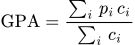
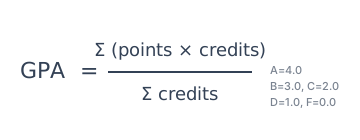
GPA equals the sum of grade points times credits divided by total credits.
GPA =
44.1 quality points ÷ 14 credits
Show Your Work
GPA = Σ(points × credits) / Σ(credits)
English Composition: 4.0 × 4 = 16
Calculus I: 3.3 × 3 = 9.9
History: 3.0 × 3 = 9
Biology: 2.3 × 4 = 9.2
Σ(points × credits) = 44.1
Σ(credits) = 14
GPA = 44.1 / 14 = 3.15
Final answer: 3.15
Share:
Weighted Grade Point Average
Convert each letter grade to its US 4.0 scale points (A = 4.0, B = 3.0, C = 2.0, D = 1.0, F = 0.0), multiply by the credit hours, sum across all courses, and divide by total credits. The credit-weighted divide makes a 5-credit class count more than a 1-credit lab.
GPA = Σ(points × credits) / Σ(credits)
How It Works
GPA — Grade Point Average — is a weighted average of your letter grades. Each letter is mapped to a number on the US 4.0 scale (A = 4.0, B = 3.0, C = 2.0, D = 1.0, F = 0.0, with +/- modifiers adding or subtracting 0.3 or 0.4). Multiply each course's points by its credit hours to get quality points, sum all quality points, then divide by total credits. The credit weighting is what separates GPA from a simple letter average: a 4-credit A counts twice as much as a 2-credit A. Use this calculator for a single semester or, by entering every course you've taken, your cumulative GPA.
Example Problem
Find the semester GPA for a student who took four courses: English Composition (A, 4 credits), Calculus I (B+, 3 credits), History (B, 3 credits), and Biology (C+, 4 credits).
Convert each letter to 4.0-scale points: A = 4.0, B+ = 3.3, B = 3.0, C+ = 2.3.
Multiply each grade by its credit hours: 4.0 × 4 = 16.0, 3.3 × 3 = 9.9, 3.0 × 3 = 9.0, 2.3 × 4 = 9.2.
Sum the quality points: 16.0 + 9.9 + 9.0 + 9.2 = 44.1 total quality points.
Sum the credit hours: 4 + 3 + 3 + 4 = 14 total credits.
Divide quality points by total credits: 44.1 / 14 = 3.15.
The semester GPA is 3.15 on the 4.0 scale.
A GPA of 3.15 corresponds to a solid B (B average is 3.0; B+ is 3.3). Most graduate programs and competitive scholarships look for a 3.0 minimum, and dean's list typically begins at 3.5.
Key Concepts
Three GPA distinctions trip people up most often. First, weighted vs unweighted: an unweighted GPA caps at 4.0 and treats every course the same; a weighted GPA can exceed 4.0 because Advanced Placement, International Baccalaureate, and Honors courses add a 0.5–1.0 bonus (so an A in an AP class can count as 5.0). This calculator uses the standard unweighted 4.0 scale. Second, semester vs cumulative: a semester GPA averages one term's courses; a cumulative GPA averages every course you've ever taken, weighted by credit. Add every course across all semesters to compute cumulative. Third, +/- modifiers: most US scales add 0.3 for + and subtract 0.3 for - (A− = 3.7, B+ = 3.3, etc.). Some institutions use unsigned grades only (just A, B, C, D, F), in which case ignore the +/- options.
Applications
College admissions — most US universities require a cumulative high school GPA of 3.0 or higher; selective schools expect 3.7+.
Dean's list and honors — typical thresholds are 3.5 (dean's list), 3.7 (cum laude), 3.8 (magna cum laude), 3.9 (summa cum laude).
Scholarship eligibility — many merit scholarships require a 3.0 or 3.5 minimum cumulative GPA each term.
Academic probation and retention — most schools place students on probation below 2.0; graduate programs typically require 3.0 to stay in good standing.
Graduate school applications — competitive programs (medical, law, top MBAs) commonly look for a 3.5+ undergraduate GPA.
Professional licensure — some board exams and clinical programs weight applicant rankings partly on GPA.
Common Mistakes
Forgetting to weight by credit hours — a simple average of letter grades undercounts high-credit classes and overcounts 1-credit labs. Always multiply by credits before summing.
Using a 4.3 scale for A+ when your school caps A+ at 4.0 — check your registrar's official scale. This calculator uses the most common variant where A and A+ both equal 4.0.
Confusing semester GPA with cumulative GPA — a 4.0 semester after a 2.0 semester doesn't make your cumulative 3.0 unless both terms have equal credits.
Mixing weighted and unweighted scales — if your transcript adds bonus points for AP/Honors classes, don't run those grades through an unweighted calculator without adjusting.
Dropping pass/fail courses entirely — most schools exclude P/F credits from GPA calculation but still count them toward graduation. Don't add them as A's.
Treating a withdraw (W) as an F — withdraws typically don't factor into GPA at all. Only enter courses with a real letter grade.
Frequently Asked Questions
How do you calculate GPA?
Convert each letter grade to its 4.0-scale points (A = 4.0, B = 3.0, C = 2.0, D = 1.0, F = 0.0), multiply by the credit hours for that course to get quality points, sum the quality points across all courses, then divide by the sum of credit hours. The result is your credit-weighted grade point average.
What is the formula for GPA?
GPA = Σ(points × credits) / Σ(credits). The numerator adds up grade-point × credit-hour products for every course; the denominator adds up just the credit hours. The +/- modifiers add or subtract 0.3 (so A− = 3.7, B+ = 3.3, B− = 2.7, etc.), and the result is on a 0.0–4.0 scale.
What is a 3.5 GPA?
A 3.5 GPA sits halfway between a straight B (3.0) and a straight A (4.0). On a letter scale it corresponds to a mix of A's and B's — typically more A's than B's, weighted by credit. Most schools place 3.5 at the dean's-list threshold, and many scholarships require at least 3.5 to renew.
How do you calculate cumulative GPA?
Add every course you've ever taken to the calculator — not just one semester — and let the credit-weighted divide handle the rest. Cumulative GPA = total quality points across all terms / total credits across all terms. You cannot simply average the individual semester GPAs unless every semester carried equal credits.
Is A+ the same as A?
On the most widely used 4.0 scale, yes — both A+ and A map to 4.0 points, and the scale is capped at 4.0. Some schools use a 4.3 scale where A+ = 4.3, and weighted high-school scales can push A+ in AP courses to 5.0. Check your institution's official conversion table.
What is the difference between weighted and unweighted GPA?
Unweighted GPA caps at 4.0 and treats every course equally on the standard 0.0–4.0 scale. Weighted GPA adds bonus points (typically 0.5 or 1.0) for honors, AP, or IB courses, so an A in an AP class can count as 5.0 and the overall GPA can exceed 4.0. This calculator uses the unweighted scale; if your transcript shows weighted grades, enter the unweighted letter you actually earned.
What GPA do I need to graduate?
Most US colleges require a minimum cumulative GPA of 2.0 (a C average) to graduate. Many programs in nursing, engineering, or education require 2.5 or 3.0 within the major. Graduate programs typically require 3.0 to stay in good standing and complete the degree.
Do withdrawals and pass/fail grades count in GPA?
Usually no — withdrawals (W) and pass/fail (P/NP, S/U) grades typically don't affect GPA at all. They still count toward total credits attempted at some institutions, but they're excluded from the quality-points sum. Only enter courses with a real letter grade in this calculator.
Reference:
US standard 4.0 grading scale as used by the College Board, NCES, and most American colleges and universities. +/- modifiers add or subtract 0.3 from the unsigned letter; A+ and A both map to 4.0 on the capped 4.0 scale.
GPA Formula
Grade Point Average is the credit-weighted average of letter grades mapped onto the US 4.0 scale:
GPA = Σ(points × credits) / Σ(credits)
Where:
points — the grade points for each course on the 4.0 scale (A = 4.0, A− = 3.7, B+ = 3.3, B = 3.0, B− = 2.7, C+ = 2.3, C = 2.0, C− = 1.7, D+ = 1.3, D = 1.0, D− = 0.7, F = 0.0)
credits — the credit hours assigned to that course
Σ — sum across every course in the term (or every course you've taken, for cumulative GPA)
A 4.0 means straight A's; a 3.0 means a straight B average; 2.0 is a C average. Schools convert these averages back to descriptive tiers — dean's list typically starts at 3.5, cum laude around 3.7, and academic probation kicks in below 2.0.
Worked Examples
First-Semester Freshman
What is the GPA for a typical first-semester load?
A student takes English Composition (A, 4), Calculus I (B+, 3), History (B, 3), and Biology (C+, 4).
To find the new cumulative, add these 12 credits and 45.0 quality points to the prior cumulative totals (not the prior GPA), then divide.
US 4.0 Grade Scale Reference
Letter
Points
Typical % Range
A+
4.0
97–100
A
4.0
93–96
A−
3.7
90–92
B+
3.3
87–89
B
3.0
83–86
B−
2.7
80–82
C+
2.3
77–79
C
2.0
73–76
C−
1.7
70–72
D+
1.3
67–69
D
1.0
63–66
D−
0.7
60–62
F
0.0
Below 60
Percent ranges are typical US institutional cutoffs and vary by school. A and A+ both equal 4.0 on the standard capped scale; some institutions use a 4.3 scale where A+ = 4.3.
Related Calculators
Statistics Calculator — compute mean, median, and standard deviation of grade distributions