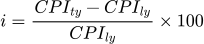
CPI-Based Inflation Rate
The CPI-based inflation rate measures how much prices have risen over a year by comparing this year’s Consumer Price Index to last year’s. The Bureau of Labor Statistics publishes CPI monthly.
i = (CPI_ty − CPI_ly) / CPI_ly × 100
Fisher Equation
The Fisher equation separates nominal interest rates into real returns and inflation. It helps investors understand whether their returns are beating inflation and growing real purchasing power.
r = n − i
How It Works
The CPI-based inflation rate measures how much prices have risen over a year by comparing this year’s Consumer Price Index to last year’s. The Fisher equation then separates nominal interest rates into real returns and inflation. Together, these tools help investors understand whether their returns are beating inflation. A savings account paying 4% with 3% inflation yields only about 1% in real purchasing power.
Example Problem
The CPI was 295.6 last year and 304.7 this year. What is the inflation rate?
- Write the CPI inflation formula: i = (CPI_ty − CPI_ly) / CPI_ly × 100.
- Substitute CPI_ty = 304.7 and CPI_ly = 295.6 into the formula.
- Compute the difference in CPI: 304.7 − 295.6 = 9.1.
- Divide by last year's CPI: 9.1 / 295.6 = 0.0308.
- Convert the decimal to a percentage by multiplying by 100.
- Inflation rate = 3.08%.
If a bond pays 5% nominal, the Fisher equation gives a real rate of 5% − 3.08% = 1.92%.
When to Use Each Variable
- Solve for Inflation Rate — when you have this year's and last year's CPI values and want to calculate the annual rate of price increase.
- Solve for Real Interest Rate — when you know the nominal interest rate and inflation rate and want to determine your actual purchasing-power gain.
Key Concepts
Inflation erodes purchasing power over time — the same dollar buys fewer goods each year. The CPI-based formula measures year-over-year price changes using a standardized basket of consumer goods. The Fisher equation separates nominal returns into real returns and inflation, revealing whether investments truly grow wealth after accounting for rising prices.
Applications
- Personal finance: evaluating whether savings account interest outpaces inflation
- Investment analysis: comparing real returns across bonds, stocks, and real estate
- Economic policy: tracking price stability to guide central bank interest rate decisions
- Salary negotiation: determining whether a raise keeps pace with the cost of living
Common Mistakes
- Comparing nominal returns without adjusting for inflation — a 6% return with 4% inflation is only 2% real growth
- Using CPI from different base years without rebasing — CPI values must use the same reference period for valid comparison
- Assuming inflation is uniform across all goods — housing, healthcare, and food often inflate at different rates than the headline CPI
Frequently Asked Questions
What is the formula for inflation rate using CPI?
The CPI formula is inflation rate = (CPI this year − CPI last year) / CPI last year × 100. If CPI rises from 250 to 260, inflation is (260 − 250) / 250 × 100 = 4%.
What is the Consumer Price Index?
The CPI tracks the average cost of a basket of consumer goods and services over time. The Bureau of Labor Statistics publishes it monthly. A CPI of 300 means prices are 3 times what they were in the base year (100).
What is the Fisher equation used for?
It separates a nominal interest rate into real return and inflation. If a bank offers 6% and inflation is 2.5%, the real return is about 3.5%. This helps investors compare opportunities across different inflation environments.
What causes inflation?
Inflation can be driven by excess demand (demand-pull), rising production costs (cost-push), or expansion of the money supply. Central banks target about 2% inflation as a sign of healthy economic growth.
What is a real interest rate?
The real interest rate is the nominal interest rate minus inflation. It reflects the actual increase in purchasing power. For example, a 6% savings rate with 2% inflation gives a real rate of 4%.
Why does inflation matter for investors?
Inflation reduces the purchasing power of future cash flows. A bond paying 4% may sound attractive, but if inflation is 3.5%, the real gain is only 0.5%. Investors use real rates to compare opportunities more accurately.
Can inflation ever be negative?
Yes. Negative inflation is called deflation. If CPI falls from 210 to 205, inflation is (205 − 210) / 210 × 100 = −2.38%. Deflation increases purchasing power, but it can also signal weak economic demand.
What is the difference between CPI inflation and the Fisher equation?
The CPI formula measures observed price change from actual CPI values. The Fisher equation relates nominal rates, real rates, and inflation to help estimate purchasing-power-adjusted returns on financial assets.
Reference:
Bureau of Labor Statistics. Consumer Price Index. U.S. Department of Labor.
Inflation Rate Formulas
This calculator covers both the CPI method for measuring inflation and the Fisher relationship between nominal return, real return, and inflation.
CPI Inflation
i = (CPI_ty − CPI_ly) / CPI_ly × 100
Fisher Equation
r = n − i
- CPI_ty = Consumer Price Index this year
- CPI_ly = Consumer Price Index last year
- i = inflation rate in percent
- n = nominal interest rate in percent
- r = real interest rate in percent
Worked Examples
Cost of Living
If CPI rises from 289.1 to 300.7, what is the inflation rate?
- i = (CPI_ty − CPI_ly) / CPI_ly × 100
- i = (300.7 − 289.1) / 289.1 × 100
- i ≈ 4.01%
Savings Account
If the nominal rate is 6.5% and inflation is 3.2%, what is the real rate?
- r = n − i
- r = 6.5 − 3.2
- r = 3.3%
Implied CPI Level
If last year's CPI was 280 and inflation is 2.5%, what is this year's CPI?
- CPI_ty = CPI_ly × (1 + i / 100)
- CPI_ty = 280 × (1 + 2.5 / 100)
- CPI_ty = 287
Related Calculators
- Interest Rate Calculator — compute simple and compound interest
- GDP Calculator — understand the broader economy
- Rule of 72 Calculator — estimate doubling time for investments
- Compounding & Discount Factors Calculator — time-value-of-money factors affected by inflation
- Present Worth Analysis Calculator — evaluate future cash flows in today's dollars
Related Sites
- Dollars Per Hour — Weekly paycheck calculator with overtime
- OptionsMath — Options trading profit and loss calculators
- Percent Off Calculator — Discount and sale price calculator
- CameraDOF — Depth of field calculator for photographers
- Medical Equations — Hemodynamic, pulmonary, and dosing calculators
- InfantChart — Baby and child growth percentile charts