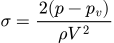
Cavitation Number
The cavitation number measures how close a flow is to forming vapor bubbles by comparing the pressure margin above vapor pressure to the dynamic pressure.
σ = 2(p − pᵥ) / (ρV²)
Pressure from Cavitation Number
Determines the local pressure required to maintain a specific cavitation number given the flow conditions.
p = (σρV² / 2) + pᵥ
Vapor Pressure
Finds the maximum allowable vapor pressure for a given cavitation number and flow conditions.
pᵥ = p − (σρV² / 2)
Density from Cavitation Number
Solves for the fluid density given the cavitation number, pressures, and velocity.
ρ = 2(p − pᵥ) / (σV²)
Velocity from Cavitation Number
Determines the maximum flow velocity before cavitation onset.
V = √(2(p − pᵥ) / (σρ))
How It Works
The cavitation number measures how close a flow is to forming vapor bubbles. It compares the difference between the local pressure and the fluid’s vapor pressure to the dynamic pressure of the flow. A lower cavitation number means the fluid is closer to boiling locally, which creates destructive vapor cavities. Engineers use it to design pumps, propellers, and valves that avoid cavitation damage.
Example Problem
A pump operates with an inlet pressure of 200 kPa absolute. The water temperature gives a vapor pressure of 2.34 kPa. The fluid density is 998 kg/m³ and the velocity at the impeller is 12 m/s. What is the cavitation number?
- Identify the known values: local pressure p = 200,000 Pa, vapor pressure pᵥ = 2,340 Pa, density ρ = 998 kg/m³, velocity V = 12 m/s.
- Write the cavitation number formula: σ = 2(p − pᵥ) / (ρV²).
- Calculate the pressure margin: p − pᵥ = 200,000 − 2,340 = 197,660 Pa.
- Calculate the numerator: 2 × 197,660 = 395,320.
- Calculate the denominator: ρV² = 998 × 144 = 143,712.
- Divide: σ = 395,320 / 143,712 ≈ 2.75. Since σ is well above 1, cavitation is unlikely at these operating conditions.
A value well above 1 suggests cavitation is unlikely at these operating conditions.
When to Use Each Variable
- Solve for Cavitation Number — when you know the local pressure, vapor pressure, density, and velocity, e.g., evaluating whether a pump impeller will cavitate at operating conditions.
- Solve for Pressure — when you need the minimum inlet pressure to maintain a safe cavitation margin.
- Solve for Vapor Pressure — when determining the maximum allowable fluid temperature before cavitation onset.
- Solve for Density — when back-calculating fluid density from measured pressures and flow velocity.
- Solve for Velocity — when finding the maximum flow speed before cavitation begins, e.g., sizing a propeller tip speed.
Key Concepts
The cavitation number compares the pressure margin above vapor pressure to the dynamic pressure of the flow. A lower value means the fluid is closer to boiling locally, which creates destructive vapor cavities that collapse violently. Engineers design pumps, propellers, and valves to operate above a critical cavitation number to prevent erosion, noise, and vibration.
Applications
- Pump design: ensuring NPSH available exceeds NPSH required to prevent impeller cavitation
- Marine propulsion: sizing propeller blade geometry to avoid tip cavitation at high RPM
- Hydraulic valves: setting minimum back-pressure to prevent cavitation downstream of control valves
- Dam spillways: designing chute profiles that maintain pressure above vapor pressure at high flow velocities
Common Mistakes
- Using gauge pressure instead of absolute pressure — vapor pressure is absolute, so all pressures must be on the same basis
- Ignoring temperature effects on vapor pressure — a 20°C increase can double water’s vapor pressure
- Assuming a fixed critical cavitation number — the critical value depends on geometry and varies from 0.5 to 3 across different equipment
- Forgetting to use consistent units — mixing kPa with Pa or psi with bar produces incorrect dimensionless results
Frequently Asked Questions
How do engineers use the cavitation number to prevent pump damage?
Engineers calculate the cavitation number at the pump inlet and compare it to the critical value specified by the manufacturer. If σ is above the critical value, there is enough pressure margin to prevent vapor bubble formation. If it is below, they increase inlet pressure (boost pump), reduce flow velocity, lower fluid temperature (to reduce vapor pressure), or select a different impeller design.
What happens when the cavitation number drops below the critical value?
Vapor bubbles form in low-pressure regions and then collapse violently when they move into higher-pressure zones. This collapse generates extreme local pressures (up to 1 GPa) and temperatures, causing pitting, erosion, noise, vibration, and performance loss. Prolonged cavitation can destroy impellers, valve seats, and propeller blades.
What does a low cavitation number mean?
A low cavitation number means the local pressure is close to the vapor pressure relative to the flow’s kinetic energy. When σ drops below a critical value (typically between 0.5 and 3 depending on geometry), vapor bubbles form and collapse violently, causing noise, vibration, and surface erosion.
How do you prevent cavitation in pumps?
Increase the inlet pressure (NPSH available), reduce fluid temperature to lower vapor pressure, or decrease flow velocity. All three actions raise the cavitation number. You can also choose a pump with a lower NPSH required or add a booster pump upstream.
What is the difference between cavitation number and NPSH?
NPSH (Net Positive Suction Head) expresses the margin above vapor pressure in meters of head, while the cavitation number normalizes that margin by the dynamic pressure. They convey the same physical idea in different units. NPSH is more common in pump specifications; σ is preferred in hydrodynamic analysis.
Can cavitation occur in any fluid?
Yes. Any liquid can cavitate if its local pressure drops below the vapor pressure. Water cavitates around 2.3 kPa at 20°C, while hydraulic oil may cavitate at even lower pressures. Even cryogenic fluids like liquid nitrogen can cavitate under the right conditions.
Why must pressures be absolute (not gauge) for the cavitation number?
Vapor pressure is an absolute pressure. If you use gauge pressure (which is zero-referenced to atmospheric), the subtraction p − pᵥ gives a wrong result. Always convert gauge to absolute by adding atmospheric pressure before using the cavitation number formula.
Cavitation Number Formula
The cavitation number is defined as:
σ = 2(p − pᵥ) / (ρV²)
Where:
- σ — cavitation number (dimensionless)
- p — local absolute pressure (Pa)
- pᵥ — vapor pressure of the liquid (Pa)
- ρ — fluid density (kg/m³)
- V — flow velocity (m/s)
A lower cavitation number means the flow is closer to forming destructive vapor bubbles. Engineers design pumps, propellers, and valves to operate above a critical σ value to prevent erosion.
Worked Examples
Pump Engineering
Will a centrifugal pump cavitate at these operating conditions?
A pump inlet has p = 200 kPa absolute, water at 20°C (pᵥ = 2,340 Pa), ρ = 998 kg/m³, and impeller velocity = 12 m/s.
- σ = 2(200,000 − 2,340) / (998 × 12²)
- σ = 395,320 / 143,712
σ ≈ 2.75
σ well above 1 means adequate margin — cavitation is unlikely at these conditions.
Marine Propulsion
What is the maximum tip speed before a ship propeller cavitates?
Seawater at 5 m depth: p ≈ 151,325 Pa, pᵥ = 2,340 Pa, ρ = 1,025 kg/m³. Critical σ for this propeller geometry is 1.5.
- V = √(2(p − pᵥ) / (σρ))
- V = √(2 × 148,985 / (1.5 × 1,025))
V ≈ 13.93 m/s
The propeller tip speed must stay below ~14 m/s to avoid cavitation at this depth.
Hydraulic Valves
What back-pressure prevents cavitation downstream of a control valve?
Water at 60°C (pᵥ = 19,940 Pa) flows at 8 m/s, ρ = 983 kg/m³. The valve requires σ ≥ 2.0 to avoid cavitation.
- p = (σρV² / 2) + pᵥ
- p = (2.0 × 983 × 64 / 2) + 19,940
p ≈ 82,852 Pa (≈ 83 kPa)
The downstream pressure must be at least 83 kPa absolute to maintain σ ≥ 2.0 and prevent cavitation damage.
Related Calculators
- Euler Number Calculator — analyze pressure losses relative to dynamic pressure
- Weber Number Calculator — compare inertial forces to surface tension in droplet and bubble flows
- Mach Number Calculator — assess compressibility effects via velocity-to-sound-speed ratio
- Bernoulli Theorem Calculator — relate pressure, velocity, and elevation in fluid flow
- Pressure Converter — convert between Pa, psi, bar, atm, and other pressure units
Related Sites
- CameraDOF — Depth of field calculator for photographers
- Z-Score Calculator — Z-score, percentile, and probability calculator
- Dollars Per Hour — Weekly paycheck calculator with overtime
- InfantChart — Baby and child growth percentile charts
- Medical Equations — Hemodynamic, pulmonary, and dosing calculators
- LoanChop — Loan prepayment calculator