Antoine Equation for Water Vapor Pressure
The Antoine equation estimates vapor pressure as a function of temperature using three experimentally determined constants (A, B, C). For water, two sets of constants cover the range from 1°C to 374°C.
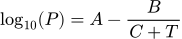
log₁₀(P) = A − B / (C + T)
How It Works
The Antoine equation estimates vapor pressure as a function of temperature using three experimentally determined constants (A, B, C). For water, two sets of constants cover the range from 1°C to 374°C. Enter a temperature to find the vapor pressure, or enter a pressure to find the boiling temperature at that pressure. A liquid boils when its vapor pressure equals the surrounding atmospheric pressure.
Example Problem
What is the vapor pressure of water at 25°C (room temperature), and how does it compare to atmospheric pressure?
- Check the temperature range. 25 °C falls in the low range (1–99 °C), so use A = 8.07131, B = 1730.63, C = 233.426.
- Substitute: log₁₀(P) = 8.07131 − 1730.63 / (233.426 + 25).
- Simplify the denominator: 233.426 + 25 = 258.426, so log₁₀(P) = 8.07131 − 1730.63/258.426.
- Divide: 1730.63/258.426 ≈ 6.6966, giving log₁₀(P) ≈ 1.3747.
- Convert out of log form: P = 10^1.3747 ≈ 23.7 mmHg.
- Compare to standard atmosphere (760 mmHg): 23.7/760 ≈ 3.1%, confirming water is a stable liquid at 25 °C and standard pressure.
This value is the saturation (equilibrium) pressure. Relative humidity at 25 °C equals the actual vapor pressure divided by 23.7 mmHg.
When to Use Each Variable
- Solve for Vapor Pressure — when you know the temperature, e.g., finding the saturation pressure of water at a given process temperature for humidity or boiling calculations.
- Solve for Temperature — when you know the pressure, e.g., determining the boiling point of water at a specific altitude or vacuum pressure.
Key Concepts
Vapor pressure is the equilibrium pressure exerted by a substance's gas phase above its liquid. It increases exponentially with temperature following the Clausius-Clapeyron relation. The Antoine equation provides a practical three-constant approximation that is accurate to within about 1% across the full liquid range of water (1-374 degrees C).
Applications
- Chemical engineering: designing distillation columns and flash separators based on boiling point predictions
- Meteorology: calculating relative humidity and dew point from temperature and actual vapor pressure
- HVAC design: sizing humidifiers and dehumidifiers for building comfort and process control
- Food processing: determining vacuum levels needed for low-temperature evaporation and freeze-drying
- Environmental science: modeling evaporation rates from lakes, reservoirs, and cooling ponds
Common Mistakes
- Using the wrong set of Antoine constants — water has two standard ranges (1-100 C and 100-374 C) with different A, B, C values
- Confusing absolute and gauge pressure — the Antoine equation gives absolute vapor pressure, not gauge pressure relative to atmosphere
- Forgetting that dissolved solutes raise the boiling point — saltwater and sugar solutions have lower vapor pressures than pure water at the same temperature
- Extrapolating beyond the valid temperature range — the Antoine equation becomes unreliable near the critical point (374 C, 22.1 MPa)
Frequently Asked Questions
What does water vapor pressure tell you about humidity?
The saturation vapor pressure at a given temperature is the upper limit on how much water vapor the air can hold. Relative humidity equals the actual vapor pressure divided by that saturation value. When the two become equal, the air is saturated and dew, fog, or condensation forms on cool surfaces.
How does the Antoine equation estimate vapor pressure?
The Antoine equation fits three empirical constants (A, B, C) to experimental vapor-pressure data, producing log₁₀(P) = A − B / (C + T). It captures the exponential Clausius–Clapeyron behavior with just algebra, so you can compute vapor pressure or boiling point with a calculator rather than numerical integration. For water, two sets of constants cover the 1–374 °C range to about 1% accuracy.
What is water vapor pressure?
Water vapor pressure is the pressure exerted by water molecules in the gas phase above a liquid water surface. It increases with temperature — at 20 °C it is about 17.5 mmHg, and at 100 °C it reaches 760 mmHg (the standard atmospheric pressure), which is why water boils at that temperature.
Why does water boil at a lower temperature at high altitude?
At high altitude, atmospheric pressure is lower. Since boiling occurs when vapor pressure equals atmospheric pressure, water reaches that threshold at a lower temperature. In Denver (5,280 ft), atmospheric pressure is about 630 mmHg, so water boils at about 95 °C instead of 100 °C.
What is the Antoine equation used for?
The Antoine equation relates vapor pressure to temperature for pure substances. It is widely used in chemical engineering for distillation design, in meteorology for humidity calculations, and in environmental science for modeling evaporation rates from lakes, soil, and cooling ponds.
How accurate is the Antoine equation for water?
With the standard published constants, the Antoine equation gives vapor pressure estimates within about 1% of measured values across the 1–374 °C range. For higher precision, the Wagner or Buck equations may be used, particularly near the critical point or below the triple point.
What is the vapor pressure of water at body temperature?
At 37 °C (98.6 °F), the vapor pressure of water is approximately 47 mmHg. This value is important in respiratory physiology because inhaled air becomes fully saturated with water vapor in the lungs, reducing the partial pressure available for oxygen transfer.
Antoine Equation for Water
The Antoine equation relates saturation vapor pressure to temperature using three empirical constants:
log₁₀(P) = A − B / (C + T)
Where:
- P — saturation vapor pressure in millimeters of mercury (mmHg)
- T — temperature in degrees Celsius (°C)
- A, B, C — Antoine constants, substance-specific
Water uses two sets of Antoine constants covering the full liquid range:
- Low range (1–99 °C): A = 8.07131, B = 1730.63, C = 233.426
- High range (99–374 °C): A = 8.14019, B = 1810.94, C = 244.485
Near the critical point (374 °C, 22.1 MPa) the equation breaks down; use steam tables or the Wagner equation for extreme conditions.
Worked Examples
HVAC Design — Condensation Prevention
Will moisture condense on a chilled-water pipe at 7 °C in a 25 °C, 60% RH room?
The room air at 25 °C has saturation vapor pressure about 23.8 mmHg. Actual vapor pressure at 60% RH is 0.60 × 23.8 = 14.3 mmHg. The pipe surface at 7 °C has a saturation pressure of:
- log₁₀(P) = 8.07131 − 1730.63 / (233.426 + 7) = 0.8735
- P = 10^0.8735 ≈ 7.47 mmHg
- Room actual vapor pressure (14.3) > pipe saturation (7.5), so condensation will form.
Saturation at pipe surface ≈ 7.5 mmHg
Engineers specify vapor-barrier insulation with a surface above the dew point (~17 °C here) to prevent drips that damage ceilings and promote mold.
Chemical Engineering — Distillation Design
At what temperature does water boil under a 100 mmHg vacuum?
A vacuum distillation column operates at 100 mmHg absolute to reduce thermal damage to heat-sensitive products. What is the boiling temperature of water at that pressure?
- log₁₀(100) = 2
- T = 1730.63 / (8.07131 − 2) − 233.426
- T = 1730.63 / 6.07131 − 233.426
T ≈ 51.6 °C
Lowering the pressure drops the boiling point nearly 50 °C — critical for preserving flavor compounds in food processing or avoiding decomposition in pharmaceutical distillation.
Atmospheric Science — Cloud Formation
What saturation vapor pressure does moist air reach at the cloud base (15 °C)?
A parcel of air rises adiabatically and cools from the surface to 15 °C at the lifting condensation level. The saturation vapor pressure at that cloud-base temperature sets when the air becomes fully saturated.
- Low-range Antoine: A = 8.07131, B = 1730.63, C = 233.426
- log₁₀(P) = 8.07131 − 1730.63 / (233.426 + 15) = 1.104
- P = 10^1.104 ≈ 12.72 mmHg
P ≈ 12.7 mmHg (≈ 1.70 kPa)
Once the parcel's actual vapor pressure reaches this saturation value, additional cooling condenses water vapor into cloud droplets. Meteorologists use this threshold to predict cloud base heights and precipitation.
Saturation Vapor Pressure of Water vs Temperature
Standard steam-table values for the saturation vapor pressure of water across the common liquid range. Click a row to load that temperature into the calculator above and solve for the vapor pressure; your unit selections are otherwise preserved.
| Temperature (°C) | Vapor pressure (kPa) | Vapor pressure (mmHg) |
|---|---|---|
| 5 | 0.8726 | 6.545 |
| 10 | 1.228 | 9.212 |
| 15 | 1.706 | 12.79 |
| 20 | 2.339 | 17.54 |
| 25 | 3.169 | 23.77 |
| 30 | 4.245 | 31.84 |
| 35 | 5.627 | 42.2 |
| 40 | 7.381 | 55.37 |
| 50 | 12.34 | 92.59 |
| 60 | 19.93 | 149.5 |
| 80 | 47.37 | 355.3 |
| 100 | 101.3 | 760 |
Standard steam-table / ASHRAE values for the saturation vapor pressure of water (kPa authoritative; mmHg derived at 1 kPa = 7.5006 mmHg). The calculator's own Antoine-equation fit may differ from these tabulated values by roughly 1–3% because it uses a different empirical correlation. For precise work consult the NIST Chemistry WebBook or the CRC Handbook of Chemistry and Physics steam tables.
Related Calculators
- Heat Index Calculator — find the apparent temperature from air temperature and humidity
- Relative Humidity Calculator — compute relative humidity from temperature and dew point
- Ideal Gas Law Calculator — relate pressure, volume, temperature, and moles for gases
- Temperature Conversion Calculator — convert between Celsius, Fahrenheit, and Kelvin for vapor pressure equations
- Pressure Unit Converter — convert vapor pressure between mmHg, Pa, atm, and mbar
Related Sites
- CameraDOF — Depth of field calculator for photographers
- Medical Equations — Hemodynamic, pulmonary, and dosing calculators
- Dollars Per Hour — Weekly paycheck calculator with overtime
- InfantChart — Baby and child growth percentile charts
- Z-Score Calculator — Z-score, percentile, and probability calculator
- LoanChop — Loan prepayment calculator