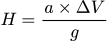
Water Hammer Surge Pressure
Water hammer calculates the maximum pressure surge when fluid flow is suddenly stopped or redirected. The wave velocity (a) depends on pipe material and fluid properties; in steel water pipes it ranges from 900–1,400 m/s.
H = a × ΔV / g
How It Works
Water hammer (H = a × ΔV / g) calculates the maximum pressure surge when fluid flow is suddenly stopped or redirected. The wave velocity (a) depends on pipe material and fluid properties; in steel water pipes it ranges from 900–1,400 m/s. The resulting pressure spike can burst pipes, so engineers use slow-closing valves, surge tanks, and arrestors to mitigate it.
Example Problem
A steel water pipe has a wave velocity of 1,200 m/s. A valve closes suddenly, stopping flow from 2 m/s to 0. What is the surge pressure head?
- Identify the known values: wave velocity a = 1,200 m/s, velocity change ΔV = 2 m/s, gravity g = 9.81 m/s².
- Determine what we are solving for: the surge pressure head H in meters of water column.
- Write the Joukowsky equation: H = a × ΔV / g.
- Substitute the known values: H = 1,200 × 2 / 9.81.
- Perform the multiplication: 1,200 × 2 = 2,400.
- Divide by gravity: H = 2,400 / 9.81 = 244.6 m. This is about 24 bar (348 psi) above normal operating pressure — enough to rupture unprotected piping.
This extreme pressure can easily rupture unprotected piping.
When to Use Each Variable
- Solve for Surge Head — when you know wave velocity, velocity change, and gravity, e.g., predicting the maximum pressure spike from a sudden valve closure.
- Solve for Wave Velocity — when you know surge head, velocity change, and gravity, e.g., back-calculating the effective wave speed from field measurements.
- Solve for Velocity Change — when you know surge head, wave velocity, and gravity, e.g., determining how much flow reduction caused an observed pressure transient.
- Solve for Gravity — when you know surge head, wave velocity, and velocity change, e.g., verifying calculations in non-standard gravitational environments.
Key Concepts
Water hammer is a pressure transient caused by sudden changes in fluid velocity. The Joukowsky equation (H = aV/g) gives the maximum surge pressure for an instantaneous valve closure. The wave velocity depends on both the fluid bulk modulus and the pipe wall elasticity — stiffer pipes produce faster waves and higher surge pressures.
Applications
- Municipal water systems: sizing surge tanks and relief valves to protect distribution networks
- Hydroelectric power: designing penstock protection against turbine load rejection transients
- Oil and gas pipelines: preventing pipeline rupture from emergency valve closures
- Fire suppression systems: accounting for pressure surges when hydrants or sprinkler valves open rapidly
- Industrial process piping: specifying slow-closing actuators for pump discharge valves
Common Mistakes
- Assuming valve closure is instantaneous — real closures take time, and if the closure time exceeds the wave reflection period (2L/a), the actual surge is much lower than the Joukowsky equation predicts
- Using the wrong wave velocity — PVC pipes (300-600 m/s) produce much lower surges than steel pipes (900-1400 m/s) for the same flow conditions
- Ignoring friction losses in long pipelines — friction dampens the pressure wave, so the Joukowsky equation overestimates surge in very long lines
- Forgetting that surge is additive to static pressure — a 25 bar surge on a 10 bar system means the pipe must withstand 35 bar total
Frequently Asked Questions
What causes the banging noise when you shut off a faucet quickly?
The banging sound is water hammer — a pressure shockwave created when moving water is suddenly stopped. The kinetic energy of the water converts into a pressure spike that travels through the pipe at 900–1,400 m/s in metal pipes. The pipe walls flex under this pressure, creating the characteristic hammering noise.
How do you calculate the pressure spike from water hammer?
Use the Joukowsky equation: H = a × ΔV / g, where a is the wave velocity, ΔV is the velocity change, and g is gravity. To convert head to pressure: ΔP = ρ × g × H. For example, a 1,200 m/s steel pipe with 2 m/s flow stoppage produces H = 244.6 m, or about 24 bar (348 psi) above normal.
What is pressure wave velocity in a pipe?
It depends on the fluid's bulk modulus and the pipe's elasticity. Steel pipes produce waves at 900–1,400 m/s; PVC pipes are slower at 300–600 m/s, which reduces surge pressure proportionally. Ductile iron falls between at 1,000–1,200 m/s.
How do you prevent water hammer?
Use slow-closing valves (closure time > 2L/a), install surge tanks or water hammer arrestors, maintain proper pipe support, and size pipes to keep velocities below 3 m/s. Variable-speed pumps with soft start/stop reduce transient pressures significantly.
What is the critical closure time for water hammer?
The critical time is 2L/a, where L is the pipe length and a is the wave velocity. If a valve closes faster than this time, the full Joukowsky surge develops. Slower closures produce proportionally lower surges because the reflected pressure wave partially cancels the incoming wave.
Can water hammer damage pipes?
Yes. Water hammer surges can exceed the pipe's pressure rating, causing joint failures, fitting blowouts, and pipe bursts. Even repeated moderate surges cause fatigue damage over time. The surge pressure is additive to the normal operating pressure — a 25 bar surge on a 10 bar system means 35 bar total.
What is the difference between water hammer and surge?
Water hammer specifically refers to the rapid pressure transient from sudden flow stoppage (Joukowsky equation). Surge is a broader term covering all transient pressure events, including slow valve closures, pump startups, and air pocket compression. Water hammer is the most severe type of surge.
Water Hammer Formula
The Joukowsky equation gives the maximum pressure surge head from an instantaneous velocity change:
H = a × ΔV / g
Where:
- H — surge pressure head (meters of fluid column)
- a — pressure wave velocity in the pipe (m/s), depends on fluid and pipe material
- ΔV — change in fluid velocity (m/s), typically from valve closure
- g — gravitational acceleration (9.81 m/s² on Earth)
To convert surge head to pressure: ΔP = ρ × g × H, where ρ is fluid density. For water, each meter of surge head equals about 9.81 kPa (1.42 psi).
Worked Examples
Municipal Water
What pressure surge occurs when a fire hydrant valve closes suddenly?
A steel water main has a wave velocity of 1,200 m/s. A fire hydrant valve closes quickly, stopping flow from 2.5 m/s to 0. What is the surge head?
- Wave velocity: a = 1,200 m/s
- Velocity change: ΔV = 2.5 m/s
- H = 1,200 × 2.5 / 9.81
H = 305.8 m (about 3,000 kPa or 435 psi)
This extreme surge can burst unprotected fittings. Slow-closing hydrant valves and surge arrestors prevent this.
Power Plant
What velocity change caused a measured 150 m surge head during a turbine trip?
A hydroelectric penstock (steel, a = 1,100 m/s) experienced a 150 m surge head during an emergency turbine shutdown. What was the velocity change?
- Surge head: H = 150 m
- Wave velocity: a = 1,100 m/s
- ΔV = H × g / a = 150 × 9.81 / 1,100
ΔV = 1.34 m/s
Even a moderate velocity change of 1.34 m/s produces dangerous surge in a high wave-speed penstock. Surge tanks absorb this energy.
Oil Pipeline
What wave velocity does a PVC pipeline have if a 1.5 m/s shutdown produces 69 m surge?
A PVC oil pipeline experiences a 69 m surge head during an emergency shutdown that stops flow at 1.5 m/s. Back-calculate the wave velocity.
- Surge head: H = 69 m
- Velocity change: ΔV = 1.5 m/s
- a = H × g / ΔV = 69 × 9.81 / 1.5
a = 451.3 m/s
This is typical for PVC pipe (300–600 m/s). The lower wave speed compared to steel (900–1,400 m/s) produces proportionally lower surge pressures.
Related Calculators
- Fluid Pressure Calculator — calculate the static pressure component in pipe systems
- Darcy-Weisbach Calculator — determine friction losses in the piping system
- Pipe Flow Calculator — compute Reynolds number and flow velocity for surge analysis
- Sound Wave Calculator — calculate the speed of the pressure wave through the pipe fluid
- Pressure Unit Converter — convert surge pressure between psi, kPa, and bar
Related Sites
- Temperature Tool — Temperature unit converter
- LoanChop — Loan prepayment calculator
- Z-Score Calculator — Z-score, percentile, and probability calculator
- InfantChart — Baby and child growth percentile charts
- Dollars Per Hour — Weekly paycheck calculator with overtime
- Medical Equations — Hemodynamic, pulmonary, and dosing calculators