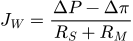
Ultrafiltration Flux Equation
Water flux depends on the net driving pressure divided by the total resistance from the membrane and any gel or fouling layer.
Jw = (ΔP − Δπ) / (Rs + Rm)
How It Works
Ultrafiltration (UF) pushes water through membranes with pore sizes of 0.01–0.1 μm, removing bacteria, colloids, and large organic molecules while passing dissolved salts. Water flux depends on the net driving pressure divided by the total resistance from both the membrane itself and any fouling or gel layer that builds up on its surface.
Example Problem
A UF membrane operates at ΔP = 200,000 Pa, Δπ = 10,000 Pa, Rm = 5×10¹² 1/m, Rs = 1×10¹² 1/m. What is the water flux?
- Identify the known values: ΔP = 200,000 Pa, Δπ = 10,000 Pa, Rs = 1×10¹² 1/m, Rm = 5×10¹² 1/m.
- We are solving for water flux Jw using Jw = (ΔP − Δπ) / (Rs + Rm).
- Calculate the net driving pressure: ΔP − Δπ = 200,000 − 10,000 = 190,000 Pa.
- Calculate the total resistance: Rs + Rm = 1×10¹² + 5×10¹² = 6×10¹² 1/m.
- Divide the net pressure by the total resistance: 190,000 / 6×10¹².
- The water flux is Jw = 3.17×10⁻⁸ m/s, which corresponds to approximately 114 L/(m²·h).
When to Use Each Variable
- Solve for Water Flux (Jw) — when you know the operating pressure, osmotic pressure, and membrane/gel resistances and need to predict the permeate flow rate.
- Solve for Pressure (ΔP) — when you need to determine the transmembrane pressure required to achieve a target flux given the membrane and fouling resistance.
- Solve for Osmotic Pressure (Δπ) — when you know the operating pressure and flux and need to back-calculate the effective osmotic pressure of the feed.
- Solve for Gel Layer Resistance (Rs) — when you want to quantify fouling by calculating the additional resistance from the gel/cake layer on the membrane surface.
- Solve for Membrane Resistance (Rm) — when you need to characterize a clean membrane's intrinsic resistance from clean-water flux test data.
Key Concepts
Ultrafiltration uses semipermeable membranes with pore sizes of 0.01–0.1 μm to remove suspended solids, bacteria, and macromolecules while passing dissolved salts. Water flux follows Jw = (ΔP − Δπ) / (Rs + Rm), where ΔP is transmembrane pressure, Δπ is osmotic pressure, Rm is intrinsic membrane resistance, and Rs is the fouling/gel layer resistance. Flux declines over time as fouling increases Rs, requiring periodic cleaning.
Applications
- Drinking water treatment: removing pathogens, turbidity, and natural organic matter as a pretreatment to disinfection
- Dairy processing: concentrating milk proteins (whey and casein) while passing lactose and minerals through the membrane
- Pharmaceutical manufacturing: separating and purifying biological products like vaccines, enzymes, and antibodies
- Industrial wastewater: recovering process water and valuable chemicals from manufacturing effluents
- Juice clarification: removing pulp and haze-forming compounds to produce clear fruit juices
Common Mistakes
- Ignoring fouling when sizing a system — design flux should be based on fouled conditions (typically 50–70% of clean-water flux), not clean membrane performance
- Confusing ultrafiltration with reverse osmosis — UF operates at 1–5 bar and rejects particles, while RO operates at 10–70 bar and rejects dissolved salts
- Using constant-flux data to predict constant-pressure performance — the two operating modes produce different fouling profiles over time
- Neglecting temperature effects on flux — water viscosity drops about 3% per °C, so warmer feed produces higher flux at the same pressure
Frequently Asked Questions
What size particles does ultrafiltration remove from water?
UF membranes have pore sizes of 0.01–0.1 μm, removing bacteria, viruses (most types), colloids, proteins, and suspended solids. They pass dissolved salts, sugars, and small organic molecules. This places UF between microfiltration (0.1–10 μm) and nanofiltration (0.001–0.01 μm) on the separation spectrum.
How does transmembrane pressure affect ultrafiltration flux?
Flux increases linearly with transmembrane pressure (ΔP) in the pressure-controlled region. Above a critical flux, concentration polarization and gel layer formation cause flux to plateau regardless of further pressure increases. Most UF systems operate at 1–5 bar to stay in the linear region.
What is the difference between ultrafiltration and reverse osmosis?
UF membranes have larger pores (0.01–0.1 μm) and remove particles at low pressure (1–5 bar). RO membranes reject dissolved salts at much higher pressures (10–70 bar). UF is used for clarification and pathogen removal; RO is used for desalination and dissolved contaminant removal.
What causes membrane fouling in ultrafiltration?
Fouling occurs when particles, organic matter, or biofilm accumulate on or within the membrane pores, increasing resistance and reducing flux. Organic fouling (proteins, humic acids), biofouling (microbial growth), and inorganic scaling (calcium, silica) are the three main types.
How often should UF membranes be cleaned?
Backwashing is typically performed every 30–60 minutes to remove loose foulants. Chemical cleaning-in-place (CIP) with caustic or acid solutions is done every 1–4 weeks depending on feed water quality. Membrane replacement is typically every 5–7 years.
What is a typical water flux for UF membranes?
Clean UF membranes typically produce 50–200 L/(m²·h) at 1–3 bar. As fouling develops, flux can drop by 30–50% between cleaning cycles. Design flux for a new system should be based on sustained fouled conditions, not peak clean-water performance.
Can ultrafiltration remove viruses from water?
UF membranes with pore sizes below 0.02 μm can achieve 4–6 log removal of most viruses. However, some very small viruses (like norovirus at 0.027 μm) may require tighter membranes or post-disinfection. UF is widely used in drinking water treatment as a barrier against pathogens.
Ultrafiltration Flux Equation
The resistance-in-series model describes permeate flux through an ultrafiltration membrane:
Jw = (ΔP − Δπ) / (Rs + Rm)
Where:
- Jw — permeate water flux (m/s or L/m²·h)
- ΔP — transmembrane pressure differential (Pa)
- Δπ — osmotic pressure of the feed (Pa)
- Rs — gel/fouling layer resistance (1/m)
- Rm — intrinsic membrane resistance (1/m)
As fouling develops, Rs increases and flux declines. Periodic backwashing or chemical cleaning restores flux by reducing the fouling layer.
Worked Examples
Drinking Water
What permeate flux does a municipal UF plant achieve?
A drinking water plant operates a UF membrane at 200,000 Pa transmembrane pressure with 10,000 Pa osmotic pressure. The membrane resistance is 5×10¹² 1/m and the fouling layer adds 1×10¹² 1/m.
- J_w = (ΔP − Δπ) / (R_s + R_m)
- J_w = (200,000 − 10,000) / (1×10¹² + 5×10¹²)
- J_w = 190,000 / 6×10¹²
J_w = 3.17×10⁻⁸ m/s
Real drinking water UF systems typically produce 50–150 L/m²·h with periodic backwashing every 30–60 minutes.
Dairy Industry
What pressure is needed to concentrate milk proteins at a target flux?
A dairy plant needs 1×10⁻⁸ m/s flux through a UF membrane to concentrate whey protein. Osmotic pressure is 50,000 Pa, membrane resistance is 2×10¹² 1/m, and fouling adds 3×10¹² 1/m.
- ΔP = J_w × (R_s + R_m) + Δπ
- ΔP = 1×10⁻⁸ × (3×10¹² + 2×10¹²) + 50,000
- ΔP = 1×10⁻⁸ × 5×10¹² + 50,000
ΔP = 50,000 + 50,000 = 100,000 Pa
In practice, dairy UF membranes operate at much lower pressures (2–5 bar) because resistance values are typically lower.
Pharmaceutical
How do you quantify membrane fouling from flux test data?
A pharmaceutical plant measures 150,000 Pa transmembrane pressure, 20,000 Pa osmotic pressure, and 2×10⁻⁸ m/s flux. The clean membrane resistance is 4×10¹² 1/m. What is the fouling layer resistance?
- R_s = (ΔP − Δπ) / J_w − R_m
- R_s = (150,000 − 20,000) / 2×10⁻⁸ − 4×10¹²
- R_s = 130,000 / 0.00000002 − 4×10¹²
R_s = 6.5×10¹² − 4×10¹² = 2.5×10¹² 1/m
Tracking R_s over time indicates when chemical cleaning is needed — typically when flux drops below 60% of clean-membrane flux.
Related Calculators
- Reverse Osmosis Calculator — design the downstream RO stage for dissolved salt removal
- Flocculation Calculator — calculate pretreatment mixing for membrane feed water
- Wastewater Screening Calculator — protect membranes with upstream screening
- Fluid Pressure Calculator — determine transmembrane pressure driving the filtration process
- Pressure Unit Converter — convert membrane operating pressure between psi, bar, and kPa
Related Sites
- CameraDOF — Depth of field calculator for photographers
- Medical Equations — Hemodynamic, pulmonary, and dosing calculators
- Hourly Salaries — Hourly wage to annual salary converter
- RN Calc — Nursing dosage and calculation tools
- InfantChart — Baby and child growth percentile charts
- Z-Score Calculator — Z-score, percentile, and probability calculator