AJ Designer

Torque Converter

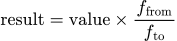
result equals value times from-factor divided by to-factor

Torque Conversion =

1 Newton-Meter (N·m)

Solution in Other Units

UnitValue
Newton-Meter (N·m)1
Kilonewton-Meter (kN·m)0.001
Pound-Foot (lbf·ft)0.73756215
Pound-Inch (lbf·in)8.8507458
Dyne-Centimeter (dyn·cm)1
Dyne-Meter (dyn·m)100000
Gram-Centimeter (g·cm)10197.214
Gram-Meter (g·m)101.97162
Kilogram-Centimeter (kg·cm)10.197162
Kilogram-Meter (kg·m)0.10197162
Newton-Centimeter (N·cm)100
Newton-Millimeter (N·mm)1000
Share:

Torque Unit Conversion

This converter transforms a torque value from one unit into all other supported torque units.

result = value × (from factor / to factor)

How It Works

This converter transforms a torque value from one unit into all other supported torque units. Each unit is defined relative to the Newton-meter (N·m) as the base unit.

Example Problem

Convert 50 newton-meters (N·m) to foot-pounds (ft·lbf).

  1. 1 N·m = 0.7376 ft·lbf.
  2. 50 × 0.7376 = 36.88 ft·lbf.

Key Concepts

Torque is a rotational force measured as force times lever arm distance. The SI unit is the Newton-meter (N·m), and the most common imperial unit is the foot-pound (ft·lbf). Conversion between torque units uses the base relationship 1 N·m = 0.7376 ft·lbf. Other units like kilogram-force-meter (kgf·m) and inch-pound (in·lbf) are common in automotive and fastener specifications.

Applications

  • Automotive repair: converting torque specifications between N·m and ft·lbf for tightening engine bolts, lug nuts, and suspension fasteners
  • Industrial equipment: converting motor output torque between SI and imperial units for specification sheets and procurement
  • Aerospace fasteners: working with inch-pound (in·lbf) torque specs common in aircraft maintenance manuals
  • International engineering: translating between kgf·m (common in Japanese and European older specs) and N·m or ft·lbf

Common Mistakes

  • Confusing Newton-meters (N·m) with Joules (J) — they share the same dimensions but measure different physical quantities (torque vs. energy)
  • Mixing up foot-pounds of torque (ft·lbf) with foot-pounds of energy (ft·lb) — context matters when the same unit name appears in different fields
  • Forgetting the force type in kgf·m — kilogram-force is a gravitational unit (9.80665 N), not the same as kilogram-mass

Frequently Asked Questions

What is torque?

Torque is a rotational force measured as the product of force and the perpendicular distance from the axis of rotation. The SI unit is the Newton-meter (N·m).

How do you convert N·m to lb·ft?

Divide the N·m value by approximately 1.3558. For example, 100 N·m ≈ 73.76 lb·ft.

What is the difference between torque and force?

Force acts in a straight line, while torque causes rotation. Torque equals force multiplied by the lever arm distance.

Related Calculators

Related Sites