How It Works
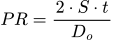
Barlow's formula relates a steel pipe's pressure rating to its allowable stress, wall thickness, and outside diameter. For smooth wall steel pipe, the allowable stress is typically 50% of the yield strength. This calculator lets you solve for any one of the four variables when the other three are known.
Example Problem
A steel pipe has S = 17,500 psi, wall thickness 0.375 in, and outside diameter 12.75 in. Find the pressure rating.
- Identify the known values: allowable stress S = 17,500 psi, wall thickness t = 0.375 in, outside diameter Do = 12.75 in.
- Select the appropriate formula: PR = 2 × S × t / Do.
- Substitute values into the equation: PR = 2 × 17,500 × 0.375 / 12.75.
- Multiply the numerator: 2 × 17,500 × 0.375 = 13,125.
- Divide by the outside diameter: 13,125 / 12.75 = 1,029.4.
- The pressure rating is approximately 1,029 psi, representing the maximum safe internal pressure for this pipe.
When to Use Each Variable
- Solve for Pressure Rating — when you know the pipe material, wall thickness, and diameter, e.g., determining the maximum operating pressure for an existing pipeline.
- Solve for Allowable Stress — when you know the pressure rating, wall thickness, and diameter, e.g., verifying which steel grade is needed for a given service pressure.
- Solve for Wall Thickness — when you know the design pressure, material stress, and pipe diameter, e.g., selecting a pipe schedule for a new installation.
- Solve for Outside Diameter — when you know the pressure, stress, and wall thickness, e.g., determining the largest pipe that can safely operate at a given pressure with available wall thickness.
Key Concepts
Barlow's formula calculates the internal pressure capacity of a thin-walled cylindrical pipe based on its material strength, wall thickness, and outside diameter. The allowable stress is typically set at 50% of the material's yield strength, providing a safety factor against variations in material properties, manufacturing tolerances, and service degradation. This formula is fundamental to pipe sizing in oil and gas, water distribution, and industrial process piping.
Applications
- Oil and gas pipelines: determining pipe wall thickness for transmission lines at specified design pressures
- Water distribution: selecting pipe schedules for municipal water mains based on operating and surge pressures
- Process piping: verifying that existing plant piping can handle new operating conditions after a process change
- Pressure vessel inspection: back-calculating the remaining pressure capacity of corroded or thinned pipe sections
Common Mistakes
- Using yield strength instead of allowable stress — the 50% safety factor must be applied before entering the stress value
- Confusing outside diameter with inside diameter — Barlow's formula uses outside diameter, and using ID will overestimate pressure rating
- Ignoring corrosion allowance — pipe wall thins over time, so the effective thickness for pressure calculations decreases with age
- Applying Barlow's formula to thick-walled pipes — the thin-wall assumption breaks down when wall thickness exceeds about 10% of the diameter
Frequently Asked Questions
How do you calculate the working pressure of a steel pipe?
Use Barlow's formula: PR = 2 × S × t / Do. Enter the allowable stress (50% of yield strength for steel), the wall thickness, and the outside diameter. The result is the maximum continuous working pressure.
What is the difference between Schedule 40 and Schedule 80 steel pipe?
Schedule 40 and Schedule 80 refer to wall thickness standards. Schedule 80 pipe has a thicker wall than Schedule 40 for the same nominal diameter, so its pressure rating is higher. For example, 4-inch Schedule 40 has a wall of 0.237 in versus 0.337 in for Schedule 80.
Why is allowable stress 50% of yield strength?
The 50% factor provides a safety margin against variations in material properties, wall thickness tolerances, and corrosion over the pipe's service life. Some codes use different percentages for specific applications.
What are typical steel pipe yield strengths?
Common grades include A53 Grade B at 35,000 psi, A106 Grade B at 35,000 psi, and API 5L X52 at 52,000 psi. The allowable stress at 50% would be 17,500 psi for A53/A106.
How does corrosion affect pressure rating?
Corrosion reduces wall thickness over time, directly lowering the pressure rating. Engineers add a corrosion allowance (typically 0.05–0.125 in) to the required thickness for uncoated steel pipe.
Can Barlow's formula be used for high-temperature steam piping?
Barlow's formula gives a starting point, but high-temperature service requires derating the allowable stress for creep and using ASME B31.1 or B31.3 code equations that include temperature factors, weld joint efficiency, and corrosion allowance.
Does the formula apply to welded and seamless pipe equally?
Barlow's formula applies to both, but welded pipe may require a joint efficiency factor (typically 0.85–1.0) that reduces the effective allowable stress. Seamless pipe uses a factor of 1.0.
Reference:
National Resources Conservation Service. National Engineering Handbook. 1995. USDA.
Steel Pipe Pressure Formula
Barlow's formula calculates the maximum internal pressure a steel pipe can safely withstand:
PR = 2 × S × t / Dₒ
Where:
- PR — pressure rating, the maximum safe working pressure
- S — allowable stress (typically 50% of yield strength for steel)
- t — wall thickness of the pipe
- Dₒ — outside diameter of the pipe
The 50% factor accounts for material variation, manufacturing tolerances, and long-term degradation. For ASME B31 process piping, additional factors for weld joint efficiency and temperature derating may apply.
Worked Examples
Oil & Gas
What wall thickness does a 1,440 psi gas transmission line need?
A 24-inch (Do = 24 in) API 5L X52 pipeline operates at 1,440 psi. With S = 26,000 psi (50% of 52,000), find the required wall thickness.
- t = PR × Do / (2 × S)
- t = 1,440 × 24 / (2 × 26,000)
- t = 34,560 / 52,000
t = 0.665 in
The calculated minimum is 0.665 in before adding corrosion allowance. Standard pipe (0.688 in wall) is the closest available schedule.
Fire Protection
Can Schedule 40 pipe handle a 175 psi standpipe system?
A fire standpipe uses 6-inch Schedule 40 steel pipe (Do = 6.625 in, t = 0.280 in) with A53 Grade B steel (S = 17,500 psi). Verify it meets the 175 psi requirement.
- PR = 2 × 17,500 × 0.280 / 6.625
- PR = 9,800 / 6.625
PR = 1,479 psi
The 1,479 psi rating vastly exceeds the 175 psi requirement. The pipe schedule is selected for structural strength and thread integrity, not burst pressure alone.
Steam Piping
What stress does a boiler header pipe experience at 600 psi?
A 10-inch Schedule 80 boiler header (Do = 10.75 in, t = 0.594 in) operates at 600 psi steam. Back-calculate the working stress to verify it remains within the allowable range.
- S = PR × Do / (2 × t)
- S = 600 × 10.75 / (2 × 0.594)
- S = 6,450 / 1.188
S = 5,429 psi
The working stress of 5,429 psi is well below the 17,500 psi allowable for A106 steel, providing a comfortable margin for thermal cycling and aging.
National Resources Conservation Service. National Engineering Handbook. 1995. USDA.
Related Calculators
- Aluminum Pipe Design Calculator — Barlow's formula for aluminum pipe
- Ductile Iron Pipe Calculator — wall thickness and internal pressure
- Thrust Block Calculator — size thrust blocks for pipe bends
- Stress & Strain Calculator — analyze yield stress and deformation in steel materials
- Pressure Unit Converter — convert pipe pressure between psi, kPa, and bar
Related Sites
- Dollars Per Hour — Weekly paycheck calculator with overtime
- Compare 2 Loans — Side-by-side loan comparison calculator
- Medical Equations — Hemodynamic, pulmonary, and dosing calculators
- InfantChart — Baby and child growth percentile charts
- Temperature Tool — Temperature unit converter
- LoanChop — Loan prepayment calculator