Snell's Law Calculator
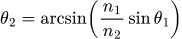
Refracted angle theta two equals arcsine of the quantity n one over n two times sine of theta one
Given the refractive indices of both media and the angle of incidence, find the angle the refracted ray makes with the normal on the far side of the interface. This is the most common Snell's law solve — used to predict where light goes when it crosses from air into glass, water, or any other transparent material.
θ₂ = arcsin((n₁ / n₂) × sin θ₁)
Solve for the angle of incidence when you already know the refracted angle. Useful for back-calculating the input ray geometry — for example, when you observe a refracted ray angle and want to determine how the original beam was aimed.
θ₁ = arcsin((n₂ / n₁) × sin θ₂)
Determine the refractive index of the first medium from a known index of the second medium and both measured angles. Used to identify an unknown transparent material by measuring how it refracts light from a calibration medium.
n₁ = n₂ × sin(θ₂) / sin(θ₁)
The mirror solve for the second medium's refractive index. Often used in introductory physics labs where students measure both angles, know n₁ (typically air at 1.0003 ≈ 1), and compute n₂ for an unknown sample.
n₂ = n₁ × sin(θ₁) / sin(θ₂)
Snell's law relates the angles a light ray makes with the normal on either side of a boundary between two transparent media. The product of each medium's refractive index and the sine of its angle from the normal is the same on both sides: n₁ × sin θ₁ = n₂ × sin θ₂. Light bends toward the normal when entering a denser medium (higher index) and away from the normal when entering a less-dense one. When light tries to leave a denser medium at a steep angle, the math demands sin θ₂ > 1 — which has no solution. That's the condition for total internal reflection.
A laser pointer in air shines at the surface of a swimming pool at a 45° angle from the vertical. The water has refractive index n₂ = 1.333. At what angle does the beam travel through the water?
If the geometry had been reversed — laser inside the water aimed up at the surface at 45° — Snell's law would give sin(θ₂) ≈ 0.9428, refracting to about 70.5° in air. Push that incident angle past θ_c ≈ 48.6° and the beam wouldn't escape at all — total internal reflection.
The refractive index n of a medium is defined as the ratio of the speed of light in vacuum c to the phase velocity v in the medium: n = c / v. Vacuum has n = 1 by definition; air is ≈ 1.0003 (often rounded to 1); water is ≈ 1.333; common crown glass is ≈ 1.50; diamond is ≈ 2.42. A higher index means light slows down more in that medium, and Snell's law shows that's exactly when the ray bends more sharply toward the normal as it enters. The reverse — leaving a denser medium for a less-dense one — bends light away from the normal, which is why a fish in a pond appears to be in a different location than where it actually is.
Apply θ₂ = arcsin((n₁ / n₂) × sin θ₁). Multiply the index ratio n₁ / n₂ by the sine of the incident angle (measured from the normal), then take the arcsine of the result to get the refracted angle. Both angles are measured from the normal, not from the surface. For air-to-water at 45°, the math gives arcsin((1.0 / 1.333) × sin 45°) = arcsin(0.5305) ≈ 32.04°.
Snell's law states n₁ × sin(θ₁) = n₂ × sin(θ₂), where n₁ and n₂ are the refractive indices of the two media and θ₁ and θ₂ are the incident and refracted angles measured from the normal. The same equation can be rearranged to solve for any of the four quantities — refracted angle, incident angle, n₁, or n₂ — when the other three are known.
The critical angle θ_c is the angle of incidence above which light cannot refract into a less-dense medium and is instead totally reflected back. It is defined only when n₁ > n₂ (light traveling from a denser medium toward a less-dense one) and given by θ_c = arcsin(n₂ / n₁). For glass (n = 1.5) to air (n = 1.0), θ_c ≈ 41.81°. For water (n = 1.333) to air, θ_c ≈ 48.6°.
Total internal reflection occurs when light traveling from a denser medium strikes the interface with a less-dense medium at an angle greater than the critical angle. Instead of refracting and crossing into the second medium, the light reflects entirely back into the first medium with no loss. This is the operating principle behind optical fibers, prismatic binoculars, and the sparkle of cut diamonds.
Pure water has a refractive index of approximately 1.333 for visible light (specifically the sodium D line at 589 nm at 20 °C). Common transparent media: air ≈ 1.0003 (rounded to 1.0 for most calculations), ice ≈ 1.31, ethanol ≈ 1.36, crown glass ≈ 1.50, flint glass ≈ 1.62, and diamond ≈ 2.42. Refractive indices depend slightly on wavelength — this dispersion is what splits white light into colors when it passes through a prism.
Light slows down when it enters water because the photons interact with the water molecules' electrons, effectively traveling at about 75% of their vacuum speed (c / 1.333 ≈ 2.25 × 10⁸ m/s). The wavefront that hits the surface first slows first, so the rest of the wavefront pivots around it like a marching band changing direction — that pivot is the refraction we see geometrically as the ray bending toward the normal.
Yes, as long as both media are transparent (or at least let some light through) and have well-defined refractive indices, Snell's law applies. It also applies to other types of waves — sound, seismic waves, and radio waves all refract according to the same sine-ratio relationship when crossing a boundary between media with different propagation speeds. The relevant 'refractive index' is just the ratio of speeds.
Always from the normal — the line perpendicular to the interface at the point where the ray hits the surface. A ray grazing the surface has a 90° incident angle in Snell's law, not 0°. A ray traveling along the normal (straight down into the interface) has a 0° incident angle and passes straight through without bending, regardless of the refractive indices.
Reference:
Hecht, Eugene. 2017. Optics. Pearson. 5th ed. — chapter 4 covers Snell's law derivation from Fermat's principle and from electromagnetic boundary conditions.
Photography & Imaging
A camera lens element made of crown glass (n = 1.52) receives light at a 35° angle of incidence from the surrounding air (n = 1.00). What's the refracted angle inside the glass?
θ₂ ≈ 22.17° — the ray bends toward the normal inside the lens
Real camera optics chain many such refractions across multiple element surfaces, each tuned to converge incoming rays onto the image sensor.
Telecommunications
A fiber's silica core has refractive index n₁ = 1.46 and is surrounded by a cladding of n₂ = 1.44. Find the critical angle above which light is trapped inside the core by total internal reflection.
θ_c ≈ 80.57° — light hitting the core–cladding interface at angles greater than this reflects back into the core
This small index difference (only 0.02) is what keeps light bouncing along the fiber over tens of kilometers with minimal loss — the operating principle behind every fiber-optic internet connection.
Marine Biology
Light from a fish 3 m underwater leaves the water (n₁ = 1.333) at an angle of 30° from the vertical and enters the air (n₂ = 1.00). At what angle does the observer see the light?
θ₂ ≈ 41.78° — the light bends away from the normal when leaving the water, making the fish appear higher and closer to the surface than it really is
Spearfishers learn to aim below the apparent fish position. Below the critical angle θ_c ≈ 48.6° for water-to-air, light escapes; beyond it, the underwater surface looks mirrored when viewed from below.
Snell's law relates the angles a light ray makes with the surface normal on either side of a boundary between two transparent media:
Where:
When n₁ > n₂ (light traveling from a denser to a less-dense medium), there is a critical incident angle θ_c above which no refraction can occur. The light is totally reflected back into the first medium — a phenomenon called total internal reflection:
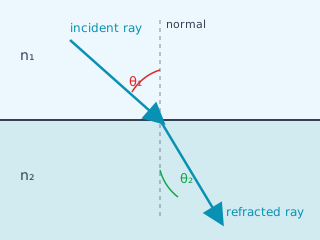
The diagram below illustrates the canonical setup: an incident ray in medium n₁ strikes the horizontal interface, refracts, and continues into medium n₂. Both angles are measured from the dashed normal line, not from the surface. When n₂ > n₁ (as drawn), the refracted ray bends toward the normal.
n₁, n₂ — refractive indices of the upper and lower media · θ₁ — angle of incidence (incident ray to normal) · θ₂ — angle of refraction (refracted ray to normal). The interface is the horizontal solid line; the dashed vertical line is the surface normal at the point of incidence.
Refractive index n (dimensionless) for common transparent media at the sodium-D wavelength. Click a medium to load its index into the n₂ field — the medium the light enters — keeping your current n₁ and incident angle. (When you're solving for n₂ itself, the row switches the calculator to solve for the refracted angle θ₂ so the looked-up index becomes a usable input.)
| Medium | Refractive index (n) |
|---|---|
| Vacuum | 1.0000 |
| Air | 1.0003 |
| Ice | 1.3100 |
| Water | 1.3330 |
| Ethanol | 1.3610 |
| Fused quartz | 1.4580 |
| Glycerin | 1.4730 |
| Acrylic (PMMA) | 1.4900 |
| Crown glass | 1.5200 |
| Polycarbonate | 1.5850 |
| Flint glass | 1.6200 |
| Sapphire | 1.7700 |
| Cubic zirconia | 2.1500 |
| Diamond | 2.4170 |
Values at ~589 nm (the sodium D line); the refractive index varies slightly with wavelength (dispersion), which is what splits white light into a spectrum through a prism. Figures are typical and follow standard optics references (CRC Handbook of Chemistry and Physics; Hecht, Optics).