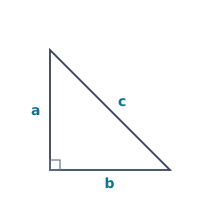
Area equals one half times a times b, and c equals the square root of a squared plus b squared
Solution
Share:
Triangle Equations
Select a triangle type and enter the known measurements. The calculator handles right triangles, equilateral triangles, scalene triangles, law of cosines, and law of sines.
K = ½ab, c = √(a² + b²)
How It Works
Select a triangle type and enter the known measurements. For right triangles the calculator uses the Pythagorean theorem. For equilateral triangles it applies s-based formulas. The law of cosines and law of sines handle oblique triangles.
Example Problem
A right triangle has legs 3 and 4. Find the hypotenuse, area, and perimeter.
Identify the knowns. Right triangle with leg a = 3 and leg b = 4, with the right angle between them. The hypotenuse c is opposite the right angle.
Identify what we're solving for. We want three quantities: the hypotenuse c, the area K, and the perimeter P.
Write the three formulas in symbols: Pythagorean theorem c = √(a² + b²); area K = ½ × a × b (the two legs are the base and height for a right triangle); perimeter P = a + b + c.
Substitute the known values: c = √(3² + 4²); K = ½ × 3 × 4; P = 3 + 4 + c.
Simplify the hypotenuse first: 3² + 4² = 9 + 16 = 25, so c = √25 = 5. Then K = ½ × 12 = 6. Then P = 3 + 4 + 5.
**c = 5, area K = 6, perimeter P = 12** — the classic 3-4-5 Pythagorean triple, so every result comes out as a whole number.
The 3-4-5 triangle is a classic Pythagorean triple, so the hypotenuse comes out exactly.
Key Concepts
Triangle calculations depend on the known measurements. Right triangles use the Pythagorean theorem (c² = a² + b²) and basic trigonometry. Equilateral triangles have all sides equal, so a single side determines everything. For oblique triangles, the Law of Cosines (c² = a² + b² − 2ab·cos C) handles SAS and SSS cases, while the Law of Sines (a/sin A = b/sin B) handles AAS and ASA cases. Area can always be computed from ½·base·height or from Heron's formula.
Applications
Surveying and land measurement: calculating plot areas and distances from angle and side measurements taken in the field
Construction: determining rafter lengths, roof pitch angles, and gable heights for framing
Navigation: solving distance and bearing problems using triangle geometry and the law of cosines
Computer graphics: decomposing polygons into triangles for rendering and collision detection
Common Mistakes
Using the Law of Sines for the ambiguous case (SSA) without checking for two possible solutions — when the given angle is acute and opposite a shorter side, two valid triangles may exist
Forgetting to convert degrees to radians when using trig functions in programming or scientific calculators set to radian mode
Applying the Pythagorean theorem to non-right triangles — use the Law of Cosines instead, which reduces to Pythagorean when the angle is 90°
Confusing altitude (height) with side length — the height must be perpendicular to the chosen base for the area formula ½·b·h
Frequently Asked Questions
How to find the hypotenuse of a right triangle?
Use the Pythagorean theorem c = √(a² + b²). For legs of 5 and 12, the hypotenuse is √(25 + 144) = √169 = 13.
When do you use the law of cosines vs. the law of sines?
Use the law of cosines when you know two sides and the included angle (SAS), or all three sides (SSS). Use the law of sines when you know a side and its opposite angle plus one more measurement (AAS or ASA).
What is the area formula for an equilateral triangle?
A = (√3/4)s². For a side length of 6, the area is (√3/4) × 36 = 9√3 ≈ 15.59 square units.
How do you find the area of a triangle from base and height?
Use A = 1/2 × base × height. If base is 10 and height is 7, the area is 35 square units.
Can the law of sines have two answers?
Yes. In the SSA ambiguous case, an acute given angle can sometimes produce two valid triangles, one valid triangle, or no triangle depending on the side lengths.
What is the difference between perimeter and area in a triangle?
Perimeter is the total distance around the triangle, measured in linear units. Area measures the space inside the triangle, measured in square units.
Reference:
Reference: Standard triangle identities from Euclidean geometry and trigonometry textbooks.
Triangle Formulas
Different triangle problems call for different formulas. This calculator handles right-triangle relationships, equilateral shortcuts, basic area, and the law of cosines / law of sines for oblique triangles.
Right Triangle
K = (1 / 2)ab
c = √(a² + b²)
Equilateral
A = (√3 / 4)s²
Law of Cosines
c² = a² + b² − 2ab cos(C)
Law of Sines
a / sin(A) = b / sin(B)
Worked Examples
Carpentry
What are the key measurements of a 5-12-13 right triangle?
Hypotenuse = √(5² + 12²) = 13.
Area = (1 / 2) × 5 × 12 = 30.
Perimeter = 5 + 12 + 13 = 30.
Signage
What is the area of an equilateral triangle with side 8?
Use A = (√3 / 4)s².
A = (√3 / 4) × 8² = 16√3.
A ≈ 27.71 square units.
Surveying
With sides 7 and 9 and included angle 40°, what is side c?