Pendulum Calculator
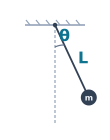
Period equals 2 pi times the square root of length divided by gravity
The period of a simple pendulum depends only on the string length and local gravity. A longer string swings more slowly; stronger gravity speeds the swing.
T = 2π√(L/g)
Frequency is the reciprocal of period. It tells you how many complete swings per second the pendulum makes under the small-angle approximation.
f = 1/(2π) × √(g/L)
A physical pendulum is any rigid body swinging about a pivot. Its period depends on the moment of inertia, mass, gravity, and distance from the pivot to the center of mass.
T = 2π√(I/(Mgd))
A simple pendulum’s period (T = 2π√(L/g)) depends only on the string length and local gravity — not on the mass of the bob or the swing angle (for small angles). A longer string swings more slowly; stronger gravity makes it swing faster. The frequency is simply f = 1/T.
A grandfather clock has a pendulum 1 m long. What is its period on Earth (g = 9.81 m/s²)?
A simple pendulum's period depends only on string length and gravitational acceleration — not on mass or amplitude (for small angles). The small-angle approximation (sin(theta) ~ theta) makes the motion simple harmonic. A physical (compound) pendulum replaces the point mass with a rigid body, so its period also depends on the moment of inertia and the distance from the pivot to the center of mass.
No. For a simple pendulum, the period depends only on length and gravity. A heavier bob swings at the same rate as a lighter one (assuming the same string length).
The formula T = 2π√(L/g) is exact only for infinitesimally small swings. For angles up to about 15° the error is less than 0.5%, but for large swings the period increases and the formula becomes less accurate.
Yes. Measure the period T and length L, then solve for g = 4π²L/T². This method was historically used to map variations in gravity across the Earth.
T = 2π√(L/g) connects all three. Period is in seconds, length in meters, and g in meters per second squared. Rearrange to solve for L (= g(T/2π)²) or g (= 4π²L/T²) when those are unknown.
A simple pendulum is an idealized point mass on a massless string; only L and g matter. A physical (compound) pendulum is any rigid body — a rod, a plate, a swinging leg — whose period depends on its moment of inertia I, total mass M, and the pivot-to-center-of-mass distance d via T = 2π√(I/(Mgd)).
Period scales with the square root of length, so quadrupling L only doubles T. To halve the period of a clock pendulum you must shorten the rod to one quarter of its original length — which is why clockmakers use small adjustment nuts on the bob to make fine timing changes.
Local gravity g is slightly lower at the equator (Earth's rotation and equatorial bulge) and decreases with altitude. Lower g lengthens the period, so an unadjusted clock runs slow. 19th-century chronometers shipped with a regulator nut to retune the pendulum length when moved to a new latitude.
Reference:
Lindeburg, Michael R. 1992. Engineer In Training Reference Manual. Professional Publication, Inc. 8th Edition.
Civil Engineering
A Foucault pendulum hangs from a 25 m cable in a museum atrium. On Earth (g = 9.81 m/s²), what is its period T = 2π√(L/g)? This is also the slow heartbeat that times its rotation against the floor markings.
T ≈ 10.03 seconds
Big Foucault pendulums use long cables to slow the swing — the longer T, the easier it is to see Earth's rotation deflect the swing plane (about 9.4°/h at 40° latitude). The Smithsonian's original 1851 installation used a 20 m cable for the same reason.
Biomechanics
Biomechanics models a relaxed walking leg as a simple pendulum of length L ≈ 0.9 m hanging from the hip joint. On Earth, what frequency does this give from f = (1/2π)√(g/L)? This is the cadence the body naturally falls into when walking.
f ≈ 0.526 Hz (about 1 step every 1.9 s per leg, ~63 steps/min total)
Measured human walking cadence at preferred speed clusters around 110–120 steps/min total — higher than the pure-pendulum prediction because muscles add active force. The pendulum analysis explains why walking with weights on your ankles changes your natural cadence so much.
Clockmaking
A traditional seconds pendulum is one that ticks once per second — half-period of 1 s, so full period T = 2 s. On Earth (g = 9.81 m/s²), what length L = g × (T/(2π))² does that require? Pre-metric the result was tantalizingly close to 1 m, and was even briefly proposed in 1791 as the definition of the meter.
L ≈ 0.994 m (≈ 994 mm)
The Académie des sciences proposed exactly this length as the metric unit of length before the meridian-arc definition won out. Every astronomical regulator clock built in the 19th century has a rod tuned to within a few mm of this value.
The pendulum calculator covers three related equations that describe oscillating swinging motion under gravity:
Where:
The simple pendulum formula assumes a point-mass bob on a massless string with small swing angles (under ~15°). At larger amplitudes the period increases and an elliptic-integral correction is needed. The physical pendulum formula applies to any rigid body — rods, plates, swinging limbs — and reduces to the simple pendulum when I = ML² and d = L.
