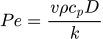
Peclet Number Equation
The Peclet number measures whether bulk fluid motion (advection) or molecular diffusion is the dominant mechanism for transporting heat or mass. A large Pe means the flow carries heat downstream much faster than it can diffuse sideways. Pe equals Re × Pr, tying together fluid motion, viscosity, and thermal properties.
Pe = vρcₚD / k
How It Works
The Peclet number measures whether bulk fluid motion (advection) or molecular diffusion is the dominant mechanism for transporting heat or mass. A large Pe means the flow carries heat downstream much faster than it can diffuse sideways, producing thin thermal boundary layers. A small Pe means diffusion spreads heat in all directions before the flow can carry it away. Pe equals the product of the Reynolds and Prandtl numbers (Pe = Re × Pr), tying together fluid motion, viscosity, and thermal properties in a single parameter.
Example Problem
Water (ρ = 998 kg/m³, cₚ = 4,182 J/(kg·K), k = 0.6 W/(m·K)) flows at 0.5 m/s through a 0.01 m tube. What is the Peclet number?
- Identify the known values: velocity v = 0.5 m/s, density ρ = 998 kg/m³, heat capacity cₚ = 4,182 J/(kg·K), tube diameter D = 0.01 m, thermal conductivity k = 0.6 W/(m·K).
- Determine what we are solving for: the Peclet number Pe, which quantifies advective vs. diffusive transport.
- Write the Peclet number equation: Pe = v × ρ × cₚ × D / k.
- Substitute the known values: Pe = 0.5 × 998 × 4,182 × 0.01 / 0.6.
- Compute the numerator: 0.5 × 998 × 4,182 × 0.01 = 20,868.18.
- Divide by conductivity: Pe = 20,868.18 / 0.6 = 34,780. Advection overwhelmingly dominates heat transport in this pipe.
Pe ≫ 1 confirms that advection overwhelmingly dominates heat transport in this pipe, as expected for liquid water at moderate flow speeds.
When to Use Each Variable
- Solve for Peclet Number — when you know all fluid and flow properties and need to characterize the transport regime.
- Solve for Velocity — when you know Pe and need to determine the flow speed required for a given transport regime.
- Solve for Density — when back-calculating fluid properties from known Pe and other parameters.
- Solve for Conductivity — when determining the thermal conductivity needed to achieve a target Pe.
Key Concepts
The Peclet number is a dimensionless ratio of advective transport rate to diffusive transport rate. For heat transfer, Pe = Re x Pr; for mass transfer, Pe = Re x Sc. When Pe >> 1, advection dominates and thermal/concentration boundary layers are thin. When Pe << 1, diffusion dominates and the temperature or concentration field spreads in all directions regardless of flow.
Applications
- Heat exchanger design: determining whether diffusion or flow dominance controls boundary layer thickness
- Microfluidics: characterizing mixing regimes in lab-on-a-chip devices where Pe can be small
- Environmental engineering: predicting contaminant transport in groundwater (advection vs. dispersion)
- Metallurgy: analyzing heat transport in liquid metal cooling systems where Pr and Pe are very low
Common Mistakes
- Confusing the thermal Peclet number (Re x Pr) with the mass-transfer Peclet number (Re x Sc) — they use different diffusivities and can differ by orders of magnitude
- Assuming Pe is always large — in liquid metals (Pr ~ 0.01) or microfluidic devices, Pe can be near or below 1, making diffusion the dominant mechanism
- Using the wrong characteristic length — pipe diameter for internal flow vs. plate length for external flow changes the Peclet number and the applicable correlations
Frequently Asked Questions
What does the Peclet number tell you about transport in a flow?
The Peclet number tells you whether convection (bulk fluid motion) or diffusion dominates transport. When Pe >> 1, the flow carries heat or mass much faster than diffusion can spread it. When Pe << 1, diffusion dominates and the temperature or concentration field is nearly uniform across the flow. This determines which terms in the energy equation you can neglect.
Is the Peclet number the same as Reynolds × Prandtl?
Yes, for heat transfer: Pe = Re × Pr. For mass transfer, Pe = Re × Sc (where Sc is the Schmidt number). This decomposition is useful because Re and Pr (or Sc) are often available from standard property tables, making it easy to compute Pe without knowing thermal diffusivity directly.
What does a high Peclet number mean physically?
A high Pe (much greater than 1) means the flow carries heat or mass downstream far faster than diffusion can spread it laterally. Thermal or concentration boundary layers are very thin, and upstream diffusion is negligible. Most industrial liquid flows have Pe in the thousands or higher.
When is the Peclet number small?
Pe is small in very slow flows, highly conductive fluids (like liquid metals), or very short length scales (microfluidics). In these situations, diffusion dominates and you can sometimes neglect the advective term entirely in the energy equation.
How is the Peclet number used in groundwater modeling?
In groundwater hydrology, the Peclet number compares advective transport (seepage velocity) to hydrodynamic dispersion. At field scale, Pe is typically large, meaning the contaminant plume moves with the groundwater flow. At pore scale, Pe can be small, and molecular diffusion becomes important for mixing.
What is the difference between thermal and mass Peclet number?
The thermal Peclet number uses thermal diffusivity (α = k/(ρcₚ)) in the denominator, while the mass Peclet number uses mass diffusivity (D). Since mass diffusivity in liquids is typically 100–1,000 times smaller than thermal diffusivity, the mass Pe is correspondingly larger for the same flow conditions.
Why does the Peclet number matter in microfluidics?
At the microscale, channel dimensions are so small that diffusion can compete with or dominate over convection. When Pe < 1, passive mixing by diffusion alone is sufficient. When Pe > 1, engineers must add active mixing elements (herringbone ridges, split-and-recombine channels) to achieve adequate mixing in a reasonable channel length.
Peclet Number Formula
The Peclet number is a dimensionless ratio of advective transport rate to diffusive transport rate:
Pe = v × ρ × cₚ × D / k
Where:
- Pe — Peclet number (dimensionless)
- v — flow velocity, in meters per second (m/s)
- ρ — fluid density, in kilograms per cubic meter (kg/m³)
- cₚ — specific heat capacity, in J/(kg·K)
- D — characteristic length, in meters (m)
- k — thermal conductivity, in W/(m·K)
Equivalently, Pe = Re × Pr for heat transfer, or Pe = Re × Sc for mass transfer. When Pe >> 1, advection dominates and thermal boundary layers are thin.
Worked Examples
Chemical Reactor Design
Is mixing in a tubular reactor dominated by convection or diffusion?
A reactant solution (ρ = 1,050 kg/m³, cₚ = 3,800 J/(kg·K), k = 0.5 W/(m·K)) flows at 0.3 m/s through a 0.05 m diameter tube.
- Pe = v × ρ × cₚ × D / k
- Pe = 0.3 × 1,050 × 3,800 × 0.05 / 0.5
- Pe = 59,850 / 0.5
Pe = 119,700
Pe >> 1 confirms convection overwhelmingly dominates. Axial diffusion is negligible, and a plug-flow reactor model is appropriate.
Groundwater Hydrology
Does a contaminant plume spread by advection or dispersion in an aquifer?
Groundwater seepage velocity is 0.0001 m/s through a 10 m aquifer layer. Using thermal analogy: ρ = 1,000 kg/m³, cₚ = 4,186 J/(kg·K), effective k = 2.0 W/(m·K).
- Pe = 0.0001 × 1,000 × 4,186 × 10 / 2.0
- Pe = 4,186 / 2.0
Pe = 2,093
Even at very low groundwater velocities, Pe is well above 1 at field scale, meaning advection dominates contaminant transport. Dispersion matters mainly at plume fringes.
Microfluidics
Can you rely on diffusion for mixing in a microfluidic channel?
Water (ρ = 998 kg/m³, cₚ = 4,182 J/(kg·K), k = 0.6 W/(m·K)) flows at 0.001 m/s through a 100 μm (0.0001 m) channel.
- Pe = 0.001 × 998 × 4,182 × 0.0001 / 0.6
- Pe = 0.4174 / 0.6
Pe = 0.696
Pe < 1 means thermal diffusion dominates at this scale and speed. The fluid reaches thermal equilibrium across the channel before convection carries it far downstream — ideal for passive mixing.
Related Calculators
- Nusselt Number Calculator — convective vs. conductive heat transfer at a surface
- Prandtl Number Calculator — momentum vs. thermal diffusivity, one half of Pe = Re × Pr
- Fourier Number Calculator — dimensionless time for transient heat conduction
- Reynolds Number Calculator — determine flow regime, since Pe = Re × Pr
- Thermal Diffusivity Calculator — find the diffusivity used in Peclet number calculations
Related Sites
- CameraDOF — Depth of field calculator for photographers
- Z-Score Calculator — Z-score, percentile, and probability calculator
- Dollars Per Hour — Weekly paycheck calculator with overtime
- InfantChart — Baby and child growth percentile charts
- Medical Equations — Hemodynamic, pulmonary, and dosing calculators
- LoanChop — Loan prepayment calculator