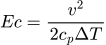
Eckert Number
Compares flow kinetic energy to thermal energy across a temperature difference.
Ec = v² ÷ (2 × cₚ × ΔT)
Velocity
Flow speed for a given viscous heating level.
v = √(2 × Ec × cₚ × ΔT)
Specific Heat
Fluid thermal capacity from flow conditions.
cₚ = v² ÷ (2 × Ec × ΔT)
Temperature Change
Boundary layer temperature gradient.
ΔT = v² ÷ (2 × Ec × cₚ)
How It Works
The Eckert number indicates whether viscous friction causes meaningful heating in a flow. When Ec is much less than 1, frictional heating is negligible and standard convection correlations apply. When Ec approaches 1 or larger, viscous dissipation significantly affects the temperature profile and must be included in thermal analysis. It arises naturally in the energy equation for boundary layers.
Example Problem
Air flows at 300 m/s over a surface. The specific heat is cₚ = 1,005 J/(kg·K) and the boundary layer temperature difference is ΔT = 50 K. What is the Eckert number?
- Identify the known values: velocity v = 300 m/s, specific heat cₚ = 1,005 J/(kg·K), temperature change ΔT = 50 K.
- Determine what we are solving for: the Eckert number Ec, which tells us if viscous heating is significant.
- Write the Eckert number formula: Ec = v² / (2 × cₚ × ΔT).
- Calculate the numerator: v² = 300² = 90,000 m²/s².
- Calculate the denominator: 2 × 1,005 × 50 = 100,500 J/kg.
- Divide: Ec = 90,000 / 100,500 ≈ 0.896. Since Ec is close to 1, viscous heating is significant and must be included in the thermal analysis.
Ec near 1 means frictional heating is significant and should not be neglected in thermal boundary layer calculations.
When to Use Each Variable
- Solve for Eckert Number — to assess whether viscous heating matters in a high-speed or high-viscosity flow.
- Solve for Velocity — to find the flow speed at which viscous heating reaches a given level.
- Solve for Specific Heat — to characterize the fluid thermal properties needed for a given Ec.
- Solve for ΔT — to find the boundary-layer temperature gradient from flow conditions.
Key Concepts
The Eckert number is a dimensionless ratio of flow kinetic energy to the enthalpy difference across a thermal boundary layer. When Ec is much less than 1, viscous dissipation is negligible and standard convection correlations apply. As Ec approaches or exceeds 1, frictional heating materially changes the temperature profile — common in high-Mach-number flows, polymer extrusion, and high-speed bearing lubrication. It is closely related to the Brinkman number (Br = Ec × Pr).
Applications
- Aerospace engineering: assessing aerodynamic heating on re-entry vehicles and supersonic aircraft surfaces
- Polymer processing: determining whether viscous shear heating in extruder barrels affects melt temperature
- Bearing design: evaluating whether lubricant temperature rise from shear friction degrades oil viscosity
- High-speed machining: predicting heat generation at the tool-chip interface during metal cutting
Common Mistakes
- Neglecting viscous dissipation when Ec is near 1 — this leads to significant errors in temperature predictions
- Confusing the Eckert number with the Brinkman number — Br includes the Prandtl number (Br = Ec × Pr) and accounts for thermal conductivity
- Using inconsistent units for velocity and specific heat — both must be in SI or both in Imperial for the ratio to be dimensionless
- Forgetting the factor of 2 in the denominator — some references define Ec without it, so check which convention your correlation uses
Frequently Asked Questions
When do you need to account for viscous heating in a flow?
When the Eckert number approaches or exceeds about 0.1–1.0, viscous dissipation is significant. This happens at high Mach numbers (supersonic flight), in very viscous fluids (polymer melts in extruders), or when the temperature difference ΔT across the boundary layer is small relative to the kinetic energy of the flow.
What does the Eckert number physically represent?
The Eckert number is the ratio of a flow’s kinetic energy (v²) to its thermal energy (cₚΔT). It tells you how important the conversion of kinetic energy to heat (via viscous friction) is compared to the existing temperature differences driving heat transfer. When Ec is large, the flow’s own motion generates heat that rivals conduction and convection.
What does the Eckert number tell you about a flow?
It quantifies the importance of viscous heating. Ec much less than 1 means frictional heating is negligible. Ec near 1 means viscous dissipation materially changes the temperature profile. Ec greater than 1 means kinetic energy dominates and adiabatic wall temperatures are significantly above the free-stream temperature.
When is the Eckert number important in engineering?
In high-speed aerodynamics (Mach 2+), re-entry vehicle design, polymer extrusion, high-speed bearings, and any application where flow speeds are high relative to the thermal energy scale. If your flow is subsonic and the fluid is not very viscous, Ec is usually negligible.
How is the Eckert number related to the Brinkman number?
Br = Ec × Pr. Both measure the importance of viscous dissipation, but the Brinkman number also accounts for the fluid’s thermal conductivity via the Prandtl number. Br is used more often in internal flows (pipe flow, extrusion), while Ec appears in external boundary-layer analysis.
What is the Eckert number for everyday flows?
For most everyday flows (water in pipes, air in buildings), Ec is on the order of 10⁻⁶ to 10⁻⁴, meaning viscous heating is completely negligible. It only becomes significant at high speeds (hundreds of m/s in air) or in high-viscosity flows with narrow gaps (polymer processing).
Does the factor of 2 matter in the Eckert number definition?
Some references define Ec = v²/(cₚΔT) without the factor of 2, while others use Ec = v²/(2cₚΔT). This calculator uses the form with the 2 in the denominator, which makes Ec directly comparable to the ratio of kinetic energy (½mv²) to thermal energy. Always check which convention your correlation uses.
Eckert Number Formula
The Eckert number is defined as:
Ec = v² / (2 × cₚ × ΔT)
Where:
- Ec — Eckert number (dimensionless)
- v — flow velocity (m/s)
- cₚ — specific heat at constant pressure, J/(kg·K)
- ΔT — temperature difference across the boundary layer (K)
When Ec is much less than 1, viscous dissipation is negligible. As Ec approaches or exceeds 1, frictional heating significantly affects temperature profiles. The related Brinkman number is Br = Ec × Pr.
Worked Examples
High-Speed Aerodynamics
Is viscous heating significant on a supersonic aircraft surface?
Air flows at 600 m/s over a wing surface. cₚ = 1,005 J/(kg·K) and the boundary layer ΔT = 100 K.
- Ec = v² / (2 × cₚ × ΔT)
- Ec = 360,000 / (2 × 1,005 × 100)
Ec ≈ 1.791
Ec > 1 means viscous heating significantly raises the surface temperature — thermal protection design is critical.
Polymer Processing
Does shear heating matter in an extruder barrel?
Polymer melt moves at 0.5 m/s through a die. cₚ = 2,000 J/(kg·K), ΔT = 20 K.
- Ec = 0.5² / (2 × 2,000 × 20)
- Ec = 0.25 / 80,000
Ec ≈ 3.125 × 10⁻⁶
Ec is extremely small — for bulk flow the kinetic term is negligible. However, localized shear zones near die walls may still produce heating (captured by the Brinkman number).
Turbomachinery
What velocity causes significant heating on a compressor blade?
A gas turbine compressor operates with cₚ = 1,005 J/(kg·K), ΔT = 50 K, and Ec = 0.5 (the design threshold for thermal concern). What is the velocity?
- v = √(2 × Ec × cₚ × ΔT)
- v = √(2 × 0.5 × 1,005 × 50)
v ≈ 224.2 m/s
Above ~224 m/s, viscous heating reaches the designer's threshold, requiring active blade cooling.
Related Calculators
- Prandtl Number Calculator — ratio of momentum to thermal diffusivity, key to boundary-layer analysis
- Nusselt Number Calculator — convective-to-conductive heat transfer ratio at a surface
- Mach Number Calculator — velocity relative to the speed of sound, central to compressible-flow heating
- Thermal Diffusivity Calculator — measure how quickly heat spreads through a material
- Speed Converter — convert between m/s, ft/s, and other velocity units
Related Sites
- CameraDOF — Depth of field calculator for photographers
- Z-Score Calculator — Z-score, percentile, and probability calculator
- Dollars Per Hour — Weekly paycheck calculator with overtime
- InfantChart — Baby and child growth percentile charts
- Medical Equations — Hemodynamic, pulmonary, and dosing calculators
- LoanChop — Loan prepayment calculator