Moment Calculator
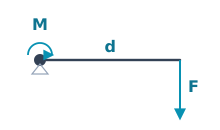
Moment equals force times perpendicular distance
A moment measures the turning effect of a force about a pivot point. The larger the force or the longer the lever arm (perpendicular distance), the greater the moment. This principle explains why a longer wrench makes it easier to loosen a bolt.
M = F × d
A moment (M = F × d) measures the turning effect of a force about a pivot point. The larger the force or the longer the lever arm (perpendicular distance), the greater the moment. This principle explains why a longer wrench makes it easier to loosen a bolt.
A 40 N force is applied at the end of a 0.25 m wrench. What moment does it produce?
That 10 N·m of torque is what you would read on a torque wrench.
A moment quantifies the rotational tendency of a force about a pivot. The perpendicular distance from the pivot to the line of action of the force is called the lever arm (or moment arm). Moments follow the principle of superposition — multiple moments about the same point add algebraically, and for static equilibrium the sum of all moments must equal zero.
Use the formula M = F × d. Multiply the applied force (in newtons) by the perpendicular distance from the pivot point (in meters). The result is the moment in newton-meters (N·m). For example, a 50 N force applied 2 m from a pivot produces a moment of 100 N·m.
The moment formula is M = F × d, where M is the moment in newton-meters, F is the applied force in newtons, and d is the perpendicular distance from the pivot to the force's line of action in meters. Rearrange to find force (F = M / d) or distance (d = M / F).
In physics, moment and torque are the same concept — both equal force times perpendicular distance (M = F × d). Engineers sometimes use 'torque' for rotation about an axis (e.g., a shaft) and 'moment' for bending effects in beams, but the underlying formula is identical.
A bending moment is the internal moment at a cross-section of a beam caused by external loads. It causes the beam to bend. At a fixed support of a cantilever beam, the bending moment equals the load times its distance from the support. Engineers use bending moment diagrams to find the maximum moment and size the beam accordingly.
Increase the lever arm (distance). Using a longer wrench or moving the force application point farther from the pivot achieves a greater moment with the same force. This is the principle behind mechanical advantage in levers.
The SI unit is the newton-meter (N·m). In imperial systems, foot-pounds (ft·lbf) or inch-pounds are common, especially in automotive and construction contexts. This calculator supports conversions between all standard torque units.
The moment is zero when the force passes directly through the pivot point (d = 0), when no force is applied (F = 0), or when the force is parallel to the line connecting its application point to the pivot. Only the perpendicular component of the force creates a moment.
Reference:
Lindeburg, Michael R. 1992. Engineer In Training Reference Manual. Professional Publication, Inc. 8th Edition.
The moment of a force measures the turning effect about a pivot point. It is defined as the product of the applied force and the perpendicular distance from the pivot to the line of action of the force:
Where:
The formula assumes the force is applied perpendicular to the lever arm. If the force acts at an angle θ to the lever arm, use M = F × d × sin(θ) to find the effective moment.
Structural Engineering
A cantilever beam is fixed at one end and free at the other. A 2,000 N load is applied at the free end, 3 m from the support.
M = 6,000 N·m
This bending moment determines the beam size and reinforcement needed at the fixed support. Real designs include safety factors and consider the beam's self-weight.
Mechanical Engineering
Given the required moment and the lever arm length, solve for the force needed at the effort end.
F = 125 N
The mechanical advantage of the lever reduces the effort force needed. A longer effort arm would reduce the required force even further.
Physics Education
The child's weight acts as the applied force, and their distance from the pivot is the lever arm.
M = 800 N·m
For the seesaw to balance, the other child must create an equal and opposite moment. A heavier child would need to sit closer to the pivot.
