Impulse & Momentum Calculator
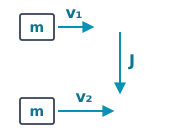
Impulse equals force times change in time
Impulse measures the effect of a force applied over a period of time. The SI unit is the newton-second (N·s). Impulse equals the change in momentum of the object.
J = F · Δt
Momentum is a property of a moving object equal to its mass times velocity. The SI unit is kg·m/s. Momentum is conserved in all collisions within a closed system.
p = m · v
An alternative form expressing impulse as mass times velocity change, useful when you know the mass and the change in speed rather than force and time.
J = m · Δv
The impulse-momentum theorem states that the change in momentum equals the impulse applied. This connects force and time to the resulting momentum change.
Δp = F · Δt
Impulse (J = F · Δt) measures the effect of a force applied over time, while momentum (p = m · v) measures an object’s motion. The impulse-momentum theorem connects them: the impulse on an object equals its change in momentum. This is why airbags work — they increase the collision time, reducing the peak force on the body.
A 0.145 kg baseball is pitched at 40 m/s and hit back at 50 m/s. The bat contacts the ball for 0.001 s. What average force does the bat exert?
The impulse-momentum theorem states that the net impulse on an object equals its change in momentum. This principle explains why extending the collision time (airbags, crumple zones) reduces peak force. Momentum is always conserved in closed systems, making it the key tool for analyzing collisions, explosions, and propulsion.
Momentum is a property of a moving object (p = mv). Impulse is the change in momentum caused by a force over time (J = F·Δt). They have the same units (N·s or kg·m/s).
Airbags increase the time over which momentum changes. Since J = F·Δt, a longer Δt means a smaller average force on the occupant for the same impulse.
Yes, total momentum is always conserved in a closed system (no external forces). Kinetic energy, however, is only conserved in perfectly elastic collisions.
The SI unit of impulse is the newton-second (N·s), which is dimensionally identical to the kilogram-meter per second (kg·m/s) used for momentum. In US customary units, impulse is sometimes given in pound-force-seconds (lbf·s); 1 lbf·s ≈ 4.448 N·s.
Force is the instantaneous push or pull on an object; impulse is force integrated over the contact duration (J = ∫ F dt, or F × Δt for constant force). A small force applied for a long time can deliver the same impulse as a large force applied briefly — which is the principle behind crumple zones, gymnast landings, and follow-through in sports.
For both, J = m × Δv applies to each object. In an elastic collision the objects bounce apart with separation speed equal to approach speed; in a perfectly inelastic collision they stick together at a common final velocity. Total momentum is conserved in both cases, but kinetic energy is only conserved in elastic collisions — the missing energy in inelastic events shows up as heat, sound, and deformation.
Specific impulse (Isp) is a rocket-engine efficiency metric: total impulse delivered per unit weight of propellant consumed, measured in seconds. A higher Isp means more momentum change per kilogram of fuel — chemical rockets reach ~450 s, ion thrusters exceed 3,000 s. It is the same impulse from this calculator, just normalized by propellant weight.
Reference:
Lindeburg, Michael R. 1992. Engineer In Training Reference Manual. Professional Publication, Inc. 8th Edition.
Sports Science
A regulation golf ball has mass m = 0.046 kg (about 1.62 oz). A driver club face accelerates it from rest to a launch speed of v = 70 m/s in a few hundred microseconds. Using the impulse-momentum theorem J = m × Δv, what total impulse does the club deliver during contact?
J ≈ 3.22 N·s
Driver contact times measured with high-speed cameras are roughly 0.45 ms, so the average force is J/Δt ≈ 3.22 / 0.00045 ≈ 7,150 N (about 1,600 lbf). Peak force is even higher because the contact pulse is not flat.
Automotive Safety
A small sedan (m = 1,200 kg) hits a barrier at v = 15 m/s (~34 mph) and a crumple zone brings it to rest over Δt = 0.15 s. The change in momentum is Δp = m × v = 1,200 × 15 = 18,000 N·s. Use Δp = F × Δt to find the average decelerating force.
F ≈ 120,000 N (120 kN)
That is roughly 10 g of deceleration on the structure — survivable for the occupants thanks to airbags, belts, and seat-back rotation that stretch the deceleration pulse further. Halving Δt to 0.075 s doubles the force, which is why a rigid wall is far more dangerous than a crumple zone of the same depth.
Aerospace Propulsion
A single Saturn V F-1 engine produced about F = 6.77 × 10⁶ N (1,522,000 lbf) of sea-level thrust and burned for roughly 150 seconds during first-stage ascent. Total impulse is J = F × Δt — a fundamental rocket-design figure of merit.
J ≈ 1.02 × 10⁹ N·s
Five F-1 engines fired in parallel made up Saturn V's S-IC first stage, so the cluster total impulse was roughly 5.08 × 10⁹ N·s — the kick that lifted 2.97 × 10⁶ kg off the pad. Total impulse divided by propellant weight gives specific impulse Isp, the propellant-efficiency metric.
Four related equations connect force, time, mass, and velocity through the impulse-momentum theorem:
Where:
The impulse-momentum theorem (J = Δp) is the time-integrated form of Newton's second law and the key tool for collision analysis. Velocity is a vector, so reversals (a ball bouncing off a wall, a bat hitting a pitched ball) flip the sign and roughly double the magnitude of Δv — easy to overlook and a common error source. Total momentum is conserved in any closed system (no external impulse); kinetic energy is only conserved in perfectly elastic collisions.
