Hydraulic Radius Equation Calculator
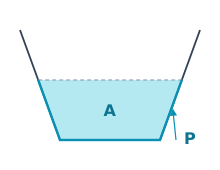
Hydraulic radius equals area divided by wetted perimeter
The hydraulic radius is the flow cross-sectional area divided by the wetted perimeter. It measures how efficiently a channel shape conveys water and appears in Manning’s and Chezy’s equations.
Rₕ = A / Pₘ
For a partially filled circular pipe, the hydraulic radius is computed from the flow depth and pipe radius using geometry of circular segments. For a full pipe of diameter D, Rₕ = D/4.
Rₕ = A / Pₘ (circular pipe)
The Froude number classifies open-channel flow as subcritical (Fr < 1), critical (Fr = 1), or supercritical (Fr > 1). It is the ratio of flow velocity to the speed of a shallow-water gravity wave.
Fr = v / √(g × hₘ)
Mean depth is the cross-sectional flow area divided by the top water surface width. It is used in the Froude number calculation and in energy equation analysis of open-channel flow.
hₘ = A / T
This calculator handles two key open-channel parameters. The hydraulic radius (Rₕ = A/Pₘ) measures channel efficiency by dividing the flow area by the wetted perimeter. The Froude number (Fr = v/√(ghₘ)) classifies flow as subcritical (Fr < 1), critical, or supercritical (Fr > 1).
A rectangular channel is 3 m wide with a flow depth of 1 m. What is the hydraulic radius?
The hydraulic radius (Rh = A/Pw) is the ratio of flow cross-sectional area to wetted perimeter. It measures how efficiently a channel shape conveys water — a higher Rh means less friction per unit of flow area. The Froude number (Fr = v/√(g·hm)) classifies open-channel flow: Fr < 1 is subcritical (slow, deep), Fr = 1 is critical, and Fr > 1 is supercritical (fast, shallow). These parameters are fundamental to Manning's equation and energy analysis in open channels.
Rₕ is the flow cross-sectional area divided by the wetted perimeter — the length of channel boundary in contact with the fluid. It shows up in Manning's and Chezy's equations as the geometric driver of flow capacity: higher Rₕ means less drag per unit of cross-section.
For a given flow area, the semicircle minimizes the wetted perimeter, maximizing Rₕ. That's why drainage culverts, irrigation ditches with curved liners, and many designed channels approximate a half-pipe — same flow rate at a smaller energy cost or smaller channel.
For a full pipe of diameter D, area is πD²/4 and the wetted perimeter is πD, so Rₕ = D/4. A 200 mm full pipe has Rₕ = 0.05 m. Partially full pipes have a different (and not always smaller) Rₕ that depends on flow depth.
Fr = v / √(g × hₘ) classifies flow regime. Fr < 1 is subcritical (slow, deep) — typical of rivers. Fr > 1 is supercritical (fast, shallow) — typical of steep flumes and downstream of spillways. Crossing Fr = 1 produces a hydraulic jump, useful for energy dissipation in stilling basins.
Flow depth y is the vertical water height at a point. Mean depth hₘ = A / T is the cross-sectional area divided by the free-surface top width — an averaged depth used in Fr and energy calculations. For a rectangular channel they are equal; for trapezoidal or natural channels they differ.
Friction only develops where the fluid contacts a solid boundary. The free water surface is in contact with air, where shear stress is negligible compared to channel walls. Including it would overstate the wetted perimeter and underpredict the hydraulic radius.
Only when the pipe runs completely full. For partial flow, area and wetted perimeter both depend on depth via circular-segment geometry — Rₕ peaks at about 0.30 m for a fully flowing 1.0 m pipe but actually reaches a slightly higher maximum near 81% depth. Use the partial-pipe formula or a pipe-flow chart.
Municipal Stormwater Channel
A municipal stormwater conveyance is a rectangular concrete channel 3 m wide flowing at a uniform depth of 0.6 m during a design storm. Compute the hydraulic radius R = A / P_w that feeds Manning's equation for the channel's design discharge.
R ≈ 0.429 m
For rectangular channels, the deeper the flow relative to the width, the closer R approaches y/2 (a very wide flow's wetted perimeter is dominated by the floor). Hydraulic radius normalizes channel shape so Manning's n and the friction slope work across all cross-sections from triangular gutters to trapezoidal flood channels.
Sanitary Sewer Design
Municipal sanitary sewers are typically designed for half-full flow to leave headspace for surges and ventilation. For a circular pipe of radius r = 0.5 m (1 m inside diameter) flowing at depth d = 0.5 m, compute the hydraulic radius using the partially-filled pipe geometry.
R ≈ 0.25 m (= D / 4)
It's a useful fact: a circular pipe flowing half-full has the same hydraulic radius as flowing full — both work out to D / 4. The full-flow capacity is twice the half-full capacity, but the friction-velocity term R^(2/3) in Manning is identical, so the velocity is the same in both cases.
Hydroelectric Spillway
A hydroelectric dam spillway delivers flow down a steep chute. At one cross-section the velocity averages 4 m/s and the mean depth (area divided by top width) is 0.6 m. Compute the Froude number Fr = v / √(g × hm) to classify the flow regime — supercritical Fr > 1 means waves cannot travel upstream and the chute is governed by the upstream control.
Fr ≈ 1.649 (supercritical flow)
Supercritical flow on a spillway is intentional — once Fr > 1, surges and ripples can't propagate back up the chute, so the upstream reservoir level and weir crest fully control the discharge. The transition from supercritical back to subcritical at the spillway toe is a hydraulic jump, where energy is dissipated in a turbulent roller (the apron / stilling basin is sized to contain it).
Four related equations describe the geometry and flow regime of an open channel:
Where:
These geometric parameters feed directly into Manning's equation (v = (1/n) × Rh2/3 × S1/2) and into specific-energy and momentum analysis of open-channel flow. For partially filled circular pipes, Rh must be computed from circular-segment geometry rather than the D/4 shortcut.
