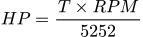
Rotating Horsepower / Torque / RPM
The fundamental relationship between rotational power, torque, and speed. The constant 5252 comes from 33,000 ft·lbf/min (one HP) divided by 2π. On any dyno chart, the torque and HP curves always cross at exactly 5,252 RPM.
HP = (T × RPM) / 5252
Dyno Correction Factor
Corrects dynamometer readings to standard atmospheric conditions. The factor accounts for ambient air pressure and temperature, which affect engine air intake and power output.
cf = 1.18 × (990/P_d) × √((T_c + 273)/298) − 0.18
Power-to-Weight Ratio
Divides vehicle power by its weight to measure performance potential. A higher ratio means faster acceleration. Useful for comparing vehicles of different sizes.
P:W = Power / Weight
ET Method HP Increase
Estimates the change in horsepower from before-and-after quarter-mile elapsed times at the same vehicle weight. Useful for measuring the effect of engine modifications.
ΔHP = W/(ET₂/5.825)³ − W/(ET₁/5.825)³
Trap Speed Method HP Increase
Estimates the change in horsepower from before-and-after quarter-mile trap speeds. Less affected by traction and driver technique than the ET method.
ΔHP = W(V₂/234)³ − W(V₁/234)³
How It Works
Horsepower measures the rate at which an engine does work. The equation HP = (Torque × RPM) / 5252 ties together rotational force, speed, and power. The constant 5252 comes from 33,000 ft·lbf/min (one HP) divided by 2π. On any dyno chart, the torque and HP curves always cross at exactly 5,252 RPM.
Example Problem
An engine produces 350 ft-lbs of torque at 4,000 RPM. What is the horsepower?
- Identify the knowns. Torque T = 350 ft-lbf measured on the dyno, engine speed RPM = 4,000 rev/min.
- Identify what we're solving for. We want the rotating horsepower HP delivered at the crankshaft at this operating point.
- Write the rotating-power equation: HP = (T × RPM) / 5,252. The constant 5,252 comes from 33,000 ft·lbf/min per HP divided by 2π — it's what makes the torque and HP curves cross at 5,252 RPM on every dyno chart.
- Substitute the known values: HP = (350 × 4,000) / 5,252.
- Simplify the arithmetic: HP = 1,400,000 / 5,252 = 266.56.
- State the final result: the engine produces **266.6 HP** at 4,000 RPM. To convert to brake horsepower at the wheels, multiply by roughly 0.85 to account for typical drivetrain losses.
When to Use Each Variable
- Solve for Horsepower — when you know torque and RPM, e.g., calculating engine power from a dyno torque reading.
- Solve for Torque — when you know horsepower and RPM, e.g., finding the torque output at a specific engine speed.
- Solve for RPM — when you know horsepower and torque, e.g., determining the engine speed where a given power and torque intersect.
- Solve for Dyno Correction Factor — when you know ambient pressure and temperature, e.g., correcting a dyno pull to standard atmospheric conditions.
- Solve for Power-to-Weight Ratio — when you know vehicle power and weight, e.g., comparing acceleration potential across different vehicles.
- Solve for HP Change (ET Method) — when you have before-and-after quarter-mile times, e.g., measuring the power gain from an engine modification.
- Solve for HP Change (Trap Speed) — when you have before-and-after trap speeds, e.g., quantifying a modification's effect using speed data.
Key Concepts
Horsepower measures the rate at which an engine does work. The fundamental equation HP = (T × RPM) / 5252 connects torque, rotational speed, and power. The constant 5252 comes from 33,000 ft·lbf/min (the definition of one HP) divided by 2π. On any dyno chart, the torque and HP curves always cross at exactly 5,252 RPM. Dyno correction factors normalize readings to standard atmospheric conditions for fair comparisons.
Applications
- Engine development: measuring and optimizing power output on a dynamometer
- Vehicle performance: predicting acceleration, top speed, and quarter-mile times from power and weight
- Dyno tuning: correcting power readings for altitude, temperature, and barometric pressure
- Motorsport: comparing before-and-after ET or trap speed data to quantify the effect of modifications
Common Mistakes
- Confusing torque and horsepower — torque is how hard the engine twists; horsepower is how fast that twist does work
- Not correcting dyno readings for atmospheric conditions — uncorrected numbers vary with weather and altitude
- Mixing brake HP (at the crank) with wheel HP (at the tires) — drivetrain losses cause a 10-20% difference
- Assuming more torque always means more power — power depends on both torque and RPM together
Frequently Asked Questions
What is the difference between torque and horsepower?
Torque is how hard the engine twists the crankshaft (measured in ft-lbs). Horsepower is how fast that twisting force does work. An engine with lots of torque but low RPM moves heavy loads slowly; one with moderate torque but high RPM achieves the same HP at higher speeds.
Why do torque and HP cross at 5,252 RPM?
Because HP = Torque × RPM / 5,252. When RPM equals 5,252, the formula simplifies to HP = Torque. This mathematical identity holds for every engine regardless of design.
How is brake horsepower different from wheel horsepower?
Brake horsepower (BHP) is measured at the crankshaft on a dynamometer. Wheel horsepower (WHP) is measured at the tires and is typically 10–20% lower due to drivetrain losses in the transmission, driveshaft, and differential.
Why do I need to correct dyno numbers for air conditions?
An engine's power output is sensitive to intake air density. Higher ambient pressure or cooler temperatures pack more oxygen into each cylinder, raising power; hot or high-altitude air does the opposite. SAE J1349 correction normalizes a pull to 990 mbar and 25 °C so two dyno sessions on different days can be compared fairly.
How does the quarter-mile ET method estimate horsepower changes?
Drag-strip elapsed time follows ET ≈ 5.825 × (W/HP)^(1/3), so the inverse cube of ET (at constant weight) is proportional to horsepower. Comparing ET before and after a modification cancels weight and traction effects and isolates the power change at the same launch conditions.
Why is the trap-speed method less sensitive than ET?
Trap speed depends mostly on power-to-weight ratio at the end of the quarter mile, where traction is no longer the limiting factor. ET is sensitive to launch quality and driver consistency. Trap speed methods give a more reliable horsepower estimate for naturally aspirated street cars.
What is a typical power-to-weight ratio for a sports car?
Modern sports cars run roughly 0.08-0.12 HP/lb (180-290 HP per metric ton). Supercars exceed 0.25 HP/lb; a daily-driver economy car is closer to 0.04 HP/lb. Power-to-weight predicts 0-60 mph times better than raw horsepower.
Reference:
Cengel, Yunus A., and Michael A. Boles. 2014. Thermodynamics: An Engineering Approach. McGraw-Hill Education. 8th ed.
Worked Examples
NASCAR Cup Engine — Rotating HP
How much horsepower does a NASCAR Cup engine make at 475 lb·ft and 8200 RPM?
A NASCAR Cup-Series small-block produces roughly 475 lb·ft of peak torque at 8200 RPM near redline. Compute the corresponding peak horsepower number — this is the formula behind every dyno chart you see in motorsports media, where the HP and torque curves always cross at exactly 5252 RPM.
- Knowns: T = 475 lb·ft, RPM = 8200
- HP = T × RPM / 5252
- HP = 475 × 8200 / 5252
- HP = 3,895,000 / 5252
HP ≈ 742 HP
The 5252 divisor is exact: 5252 = 33,000 / (2π), where 1 HP ≡ 33,000 ft·lb/min and one revolution = 2π radians. That's why every torque-and-HP chart crosses at exactly 5252 RPM — it's a mathematical identity, not a physical coincidence.
Cold Morning Dyno Pull — SAE J1349 Correction
What dyno correction factor applies to a 5 °C morning pull at 1025 mbar?
A chassis dyno session runs on a cold winter morning: dry-air pressure Pd = 1025 mbar, ambient temperature Tc = 5 °C. The denser, colder air produces inflated raw HP numbers; SAE J1349 corrects readings back to a 990 mbar / 25 °C reference so dyno sessions taken on different days can be compared. Compute the correction multiplier the dyno software applies.
- Knowns: Pd = 1025 mbar, Tc = 5 °C
- cf = 1.18 × (990 / Pd) × √((Tc + 273) / 298) − 0.18
- cf = 1.18 × (990 / 1025) × √((5 + 273) / 298) − 0.18
- cf = 1.18 × 0.9659 × √(278 / 298) − 0.18
- cf = 1.18 × 0.9659 × 0.9659 − 0.18
- cf = 1.1009 − 0.18
cf ≈ 0.921
A cf below 1.00 means the dyno software trims observed HP down to the reference day. A 500 HP raw reading at this condition reports as ~461 corrected HP. Hot, low-elevation summer pulls have cf above 1.00 and adjust upward.
Drag-Strip Tuning Pass — Trap-Speed Method
How much horsepower did the tuner pick up if trap speed went from 110 to 115 mph?
A 3200-lb drag car runs the quarter mile, traps 110 mph baseline, then 115 mph after a tuning session. The trap-speed method (Hale's formula) estimates the HP delta directly from before/after MPH at the lights, independent of any 60-foot or launch differences. Compute ΔHP.
- Knowns: W = 3200 lb, V₁ = 110 mph, V₂ = 115 mph
- ΔHP = W × (V₂ / 234)³ − W × (V₁ / 234)³
- ΔHP = 3200 × (115 / 234)³ − 3200 × (110 / 234)³
- ΔHP = 3200 × 0.11868 − 3200 × 0.10388
- ΔHP = 379.8 − 332.4
ΔHP ≈ 47.4 HP gained
Trap speed is dominated by peak HP (the air-drag cube law); ET is dominated by 60-foot and shifting. That's why bracket racers chase consistent ET while heads-up racers chase mph. The 234 constant assumes typical drag-car aero — adjust if running a high-Cd or low-Cd profile.
Horsepower Formulas
Five formulas cover rotating horsepower, dynamometer correction, and drag-strip-based horsepower estimation from elapsed time or trap speed.
HP = (T × RPM) / 5252Rotating horsepower from torque and RPM
cf = 1.18 × (990 / P_d) × √((T_c + 273) / 298) − 0.18SAE J1349 dyno correction factor
P:W = Power / WeightPower-to-weight ratio
ΔHP = W / (ET₂ / 5.825)³ − W / (ET₁ / 5.825)³ET-method horsepower change
ΔHP = W × (V₂ / 234)³ − W × (V₁ / 234)³Trap-speed method horsepower change
Where:
- HP — rotating horsepower (mechanical, brake, or wheel depending on measurement point)
- T — torque in pound-feet (ft·lbf)
- RPM — engine speed in revolutions per minute
- cf — SAE J1349 correction factor (multiply uncorrected HP by cf)
- P_d — observed dry barometric pressure in millibar
- T_c — observed ambient temperature in degrees Celsius
- P:W — power-to-weight ratio (HP per pound or kW per kg)
- W — vehicle weight in pounds
- ET₁, ET₂ — quarter-mile elapsed time before and after, in seconds
- V₁, V₂ — quarter-mile trap speed before and after, in mph
- ΔHP — horsepower change between two runs at the same weight
The 5,252 constant in HP = (T × RPM) / 5,252 is 33,000 ft·lbf/min (the definition of one mechanical horsepower) divided by 2π — that is why the torque and horsepower curves always cross at 5,252 RPM on any dyno chart. The 5.825 and 234 constants in the drag-strip equations empirically correlate quarter-mile ET and trap speed to horsepower for typical light-vehicle aerodynamics.
Related Calculators
- Horsepower from Torque Calculator — dedicated HP = (T × RPM) / 5252 page with unit conversion
- Dyno Correction Factor Calculator — SAE atmospheric correction for dyno HP readings
- Power-to-Weight Ratio Calculator — HP per pound for vehicle performance comparison
- ET Method Horsepower Calculator — change in HP from before/after quarter-mile ETs
- Trap Speed Horsepower Calculator — change in HP from before/after trap speeds
- Engine Equations Calculator — displacement and volumetric efficiency
- Torque Calculator — calculate torque from force and lever arm
- Power Unit Converter — convert between HP, watts, kW, and BTU/hr
Related Sites
- Dollars Per Hour — Weekly paycheck calculator with overtime
- Compare 2 Loans — Side-by-side loan comparison calculator
- Medical Equations — Hemodynamic, pulmonary, and dosing calculators
- InfantChart — Baby and child growth percentile charts
- Temperature Tool — Temperature unit converter
- LoanChop — Loan prepayment calculator