Doppler Effect Equations Calculator
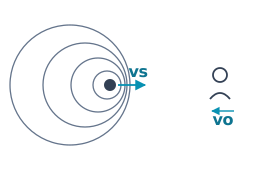
Doppler effect equation
Observed frequency increases when receiver approaches source.
f′ = f₀(1 + uᵣ/v)
Observed frequency decreases when receiver moves away.
f′ = f₀(1 − uᵣ/v)
Wavelengths compress when source approaches.
λᶠ = (v − uₛ) / f₀
Wavelengths stretch when source recedes.
λᵇ = (v + uₛ) / f₀
Frequency from compressed wavelength.
f′ = v / λᶠ
Frequency from stretched wavelength.
f′ = v / λᵇ
The Doppler effect describes how observed frequency changes when source or receiver is moving. Approaching raises frequency; moving apart lowers it. Applies to sound, radar, and light.
An ambulance siren at 700 Hz approaches at 30 m/s. Speed of sound is 343 m/s.
Higher pitch as the ambulance approaches.
The Doppler effect arises because relative motion between source and observer compresses or stretches wave crests. For sound, the wave velocity is fixed by the medium, so motion changes the observed frequency and wavelength. For light, relativistic effects must be included. The shift magnitude depends on the ratio of object speed to wave speed — faster motion produces a larger frequency change.
Wave crests compress in front of the moving source, shortening the wavelength reaching a stationary listener. Because the wave still travels at the medium's fixed speed, a shorter wavelength means a higher observed frequency — that's the rising pitch you hear as the siren approaches.
Yes — astronomers see red-shift for receding stars and blue-shift for approaching ones. For light the classical formulas only approximate the true shift; the full result needs the relativistic Doppler equation f' = f₀ × √((1 − β) / (1 + β)) once the source velocity becomes a noticeable fraction of c.
Doppler ultrasound transmits a known frequency into tissue and measures the shift in echoes returning from moving red blood cells. The frequency offset is proportional to blood velocity, which is how cardiologists noninvasively map flow through valves and arteries.
When the source moves, the wavelength in the medium changes because successive crests are emitted from progressively different positions. When the receiver moves, the wavelength in the medium is unchanged but the observer encounters crests at a different rate. The two cases obey different formulas and give slightly different shifts at the same speed.
For sound in air (v = 343 m/s), a 30 m/s ambulance produces about a 9% shift — easy to hear. For visible light (v = c ≈ 3×10⁸ m/s), you need orbital or galactic speeds for the shift to matter, which is why redshift is mostly a tool of astronomy rather than everyday measurement.
They break down when source or receiver speed approaches the wave speed. For sound, supersonic sources (uₛ ≥ v) produce shock waves rather than a Doppler-shifted tone. For light, the classical formula starts deviating from the relativistic one above a few percent of c — for accurate astronomical work you must use the relativistic Doppler equation including time dilation.
Reference:
Tipler, Paul A. 1995. Physics For Scientists and Engineers. Worth Publishers. 3rd ed.
Emergency Vehicles
An ambulance siren emits a 700 Hz tone while the ambulance drives toward a stationary listener at 25 m/s. Air temperature is 20 °C so the speed of sound is taken as 343 m/s. Find the compressed wavelength reaching the observer.
λ_f ≈ 0.454 m
The compressed wavelength is shorter than the rest-frame wavelength v/f₀ = 0.490 m, which is why the siren sounds sharper while the ambulance is approaching.
Music Acoustics
A musician sprints at 5 m/s straight toward a stationary 440 Hz A4 tuning fork through 20 °C air. Find the pitch the runner actually hears as the observer-moving Doppler shift.
f' ≈ 446.4 Hz
A 6 Hz upward shift from A4 is roughly a quarter-semitone — easily audible to a trained musician and a good test of pitch perception during physical motion.
Wave Physics
A moving source has compressed the wavelength of its emitted sound to 0.45 m in front of itself (the forward-going λ_f). For a stationary observer in 20 °C air, the speed of sound is 343 m/s. Find the observed frequency.
f' ≈ 762.2 Hz
This is the second step of the source-Doppler pipeline: once the moving source has reset the wavelength in the direction of motion, the stationary medium still propagates the wave at v, so a stationary observer reads off f' from v and the new λ.
Three pairs of equations cover the classical (non-relativistic) Doppler effect for a wave traveling through a medium. Each pair distinguishes motion toward versus motion away:
Where:
These formulas assume the source and receiver move along the line connecting them and that speeds are small compared with the wave speed v. They apply to sound in air or water, ultrasound in tissue, and ripples on a surface. For light or radio waves the source/receiver speeds can approach the wave speed (c), so the relativistic Doppler equation should be used instead — see the FAQ for the relativistic form.
The wave velocity v in the Doppler equations is the speed of sound (or any wave) through the medium between source and receiver. It is fastest through stiff, dense solids like aluminum and diamond, and slowest through soft or low-density media like rubber and air. Click a row to load that speed into the wave-velocity field above, keeping your frequency, wavelength, and source/receiver-velocity inputs and your current scenario (if you are solving for the wave velocity, the calculator switches to solving for the observed frequency or wavelength so the looked-up speed drives a result).
| Medium | Speed of sound (m/s) |
|---|---|
| Rubber | 60 |
| Air (20 °C) | 343 |
| Helium (20 °C) | 1,007 |
| Lead | 1,210 |
| Water (25 °C) | 1,493 |
| Seawater | 1,531 |
| Ice | 3,200 |
| Gold | 3,240 |
| Oak (wood) | 3,850 |
| Copper | 4,600 |
| Glass | 5,640 |
| Steel | 5,960 |
| Aluminum | 6,420 |
| Diamond | 12,000 |
Values at typical conditions (gases ~20 °C). The speed of sound rises with temperature in gases and varies with composition, density, and stiffness in liquids and solids, so treat these as representative figures. Synthesized from standard references (CRC Handbook of Chemistry and Physics; NIST; Engineering ToolBox). For more detail see the sound wave speed calculator.
