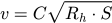
Chezy Equation — Flow Velocity
The Chezy equation relates the mean velocity of steady, uniform open-channel flow to the channel’s hydraulic radius, slope, and roughness coefficient.
v = C × √(Rₕ × S)
Chezy Equation — Chezy Coefficient
Solves for the Chezy roughness coefficient given the measured velocity, hydraulic radius, and channel slope.
C = v / √(Rₕ × S)
Chezy Equation — Hydraulic Radius
Determines the hydraulic radius from measured velocity, Chezy coefficient, and slope.
Rₕ = v² / (C² × S)
Chezy Equation — Channel Slope
Finds the channel slope needed to produce a given velocity.
S = v² / (C² × Rₕ)
Chezy-Manning — Chezy Coefficient
Converts Manning’s roughness coefficient n to the Chezy coefficient.
C = (1/n) × Rₕ^(1/6)
Chezy-Manning — Manning Roughness
Determines the Manning roughness coefficient from the Chezy coefficient and hydraulic radius.
n = Rₕ^(1/6) / C
Chezy-Manning — Hydraulic Radius
Solves for the hydraulic radius given both the Chezy coefficient and Manning roughness.
Rₕ = (C × n)⁶
How It Works
The Chezy equation relates the mean velocity of steady, uniform open-channel flow to the channel’s hydraulic radius, slope, and a roughness coefficient. Developed in the 18th century by Antoine de Chezy, it is one of the earliest formulas in hydraulic engineering. A higher Chezy coefficient means a smoother channel with less friction resistance.
Example Problem
A trapezoidal irrigation canal has a Chezy coefficient of 55, a hydraulic radius of 0.8 m, and a bed slope of 0.002. What is the flow velocity?
- Identify the knowns. Chezy coefficient C = 55 (typical for an earthen canal in good condition), hydraulic radius Rₕ = 0.8 m, and bed slope S = 0.002 (a 0.2% gradient, dimensionless).
- Identify what we're solving for. We want the mean flow velocity v of steady, uniform open-channel flow in m/s.
- Write the Chezy equation: v = C × √(Rₕ × S). Velocity scales linearly with the Chezy coefficient and with the square root of the product of hydraulic radius and slope.
- Substitute the known values: v = 55 × √(0.8 m × 0.002) = 55 × √0.0016 m.
- Simplify the radical: √0.0016 = 0.04 m^(1/2), then multiply: v = 55 × 0.04.
- State the result: v ≈ **2.2 m/s** — a typical irrigation-canal flow speed, fast enough to convey water efficiently without scouring the bed.
When to Use Each Variable
- Solve for Velocity (Chezy) — when you know the Chezy coefficient, hydraulic radius, and slope, e.g., estimating flow speed in an irrigation canal.
- Solve for Chezy Coefficient — when you have measured velocity, hydraulic radius, and slope, e.g., calibrating roughness from field data.
- Solve for Hydraulic Radius (Chezy) — when sizing a channel cross-section to achieve a target flow velocity.
- Solve for Channel Slope — when designing a canal grade to deliver a required velocity.
- Solve for Chezy from Manning — when converting a known Manning n value to the equivalent Chezy coefficient.
- Solve for Manning n — when you have a Chezy coefficient and need the Manning roughness for design tables.
- Solve for Hydraulic Radius (Manning) — when determining the hydraulic radius from both the Chezy coefficient and Manning roughness.
Key Concepts
The Chezy equation is one of the earliest open-channel flow formulas, relating mean velocity to channel roughness, hydraulic radius, and bed slope. The Chezy coefficient C encapsulates all resistance effects — a higher value means a smoother, more efficient channel. The Chezy-Manning relationship C = (1/n)R^(1/6) connects Chezy's formula to the more widely tabulated Manning roughness coefficient.
Applications
- Irrigation engineering: sizing canals and ditches for target flow rates
- Civil engineering: designing stormwater drainage channels and culverts
- Environmental engineering: estimating stream velocity for sediment transport studies
- Hydropower: calculating flow velocity in open headrace channels
Common Mistakes
- Confusing hydraulic radius with pipe radius — hydraulic radius is cross-sectional area divided by wetted perimeter, which equals D/4 for a full pipe
- Using slope in percent instead of dimensionless ratio — a 2% slope must be entered as 0.02
- Mixing up Chezy C and Manning n — a high Chezy coefficient means low roughness, but a high Manning n means high roughness
Frequently Asked Questions
What is the Chezy equation?
The Chezy equation v = C√(RₕS) calculates the average velocity of water in an open channel. It uses an empirical roughness coefficient (C) that depends on channel material and condition.
How is the Chezy coefficient related to Manning's n?
The two are related by C = (1/n) × Rₕ^(1/6). Manning's equation is more commonly used today because n values are well-tabulated for hundreds of channel materials.
What are typical Chezy coefficient values?
Values typically range from 30 for rough natural streams to 90 for smooth concrete channels. Most engineered channels fall between 50 and 70.
What is the hydraulic radius and how do you calculate it?
Hydraulic radius Rₕ = A / P, where A is the wetted cross-sectional area and P is the wetted perimeter (the length of channel surface in contact with the water). For a circular pipe flowing full, Rₕ = D/4. For a wide shallow channel, Rₕ approaches the flow depth.
When should I use Chezy versus Manning's equation?
Manning is the modern standard for open-channel design — its roughness n values are tabulated for hundreds of materials. Chezy is still useful for academic derivations, historical literature, and quick sanity checks. The two are mathematically related: Chezy is more fundamental, Manning is more practical.
Does the Chezy equation work for closed pipes?
It applies only to steady, uniform, fully developed open-channel flow (free surface exposed to atmospheric pressure). For closed pressurized pipes, use Darcy-Weisbach or Hazen-Williams. A partially full pipe (storm sewer not running full) is open-channel flow and Chezy applies.
Why does flow velocity not depend on the channel's absolute depth?
The Chezy equation depends on hydraulic radius (a ratio of area to perimeter), not on absolute size. A wide, shallow ditch and a deep, narrow channel with the same Rₕ and slope deliver the same mean velocity. Total discharge differs because Q = v × A, but the mean velocity is set entirely by Rₕ, S, and C.
Worked Examples
Storm Drainage
How fast does water flow in a rectangular concrete storm drain?
A rectangular concrete storm drain has a hydraulic radius of 2 m, a slope of 0.0015, and a Chezy coefficient of 60 m½/s. Find the flow velocity for a peak runoff design check.
- Knowns: C = 60 m½/s, Rh = 2 m, S = 0.0015
- v = C × √(Rh × S)
- v = 60 × √(2 × 0.0015) = 60 × √0.003
- v = 60 × 0.05477
v ≈ 3.29 m/s
Storm drains are typically sized for velocities between 0.6 m/s (self-cleaning minimum) and 3-4 m/s (to limit abrasion). This channel sits at the upper end and would benefit from a flatter slope or larger cross-section.
Irrigation Engineering
What Chezy coefficient does an earthen irrigation canal show?
An earthen irrigation canal carries water at 1.2 m/s with a hydraulic radius of 1.4 m and slope of 0.0008. Back-calculate the Chezy coefficient to confirm it matches the assumed roughness category.
- Knowns: v = 1.2 m/s, Rh = 1.4 m, S = 0.0008
- C = v / √(Rh × S)
- C = 1.2 / √(1.4 × 0.0008) = 1.2 / √0.00112
- C = 1.2 / 0.03347
C ≈ 35.86 m½/s
Earthen canals typically show C between 30 and 50 m½/s depending on lining and vegetation. A value near 36 is consistent with a well-maintained unlined earth canal.
River Hydraulics
How do you derive Chezy C from Manning's n for a gravel-bed stream?
A natural gravel-bed stream has a Manning roughness coefficient n = 0.030 and a hydraulic radius of 0.8 m. Use the Chezy-Manning relationship to get the equivalent Chezy coefficient for a steady-flow analysis.
- Knowns: n = 0.030, Rh = 0.8 m
- C = (1/n) × Rh^(1/6)
- C = (1/0.030) × 0.8^(1/6)
- C = 33.333 × 0.9635
C ≈ 32.12 m½/s
The Chezy-Manning bridge lets you reuse decades of tabulated Manning roughness values inside the older Chezy formula. Gravel-bed streams typically land in the 25-40 m½/s range.
Chezy & Chezy-Manning Formulas
The Chezy equation gives the mean velocity of steady, uniform open-channel flow. The Chezy-Manning relationship converts between the Chezy coefficient and the more widely tabulated Manning roughness:
v = C × √(Rₕ × S)Chezy equation — mean velocity
C = (1 / n) × Rₕ^(1/6)Chezy-Manning coefficient conversion
Where:
- v — mean flow velocity (m/s)
- C — Chezy coefficient (m½/s); higher means smoother channel
- Rₕ — hydraulic radius = cross-sectional area / wetted perimeter (m)
- S — energy / bed slope, dimensionless (e.g., 0.002 = 0.2% grade)
- n — Manning roughness coefficient (dimensionless); higher means rougher
Chezy's formula assumes steady, uniform flow in an open channel — flow depth and velocity do not change along the channel length. The hydraulic radius captures the channel geometry: a wide shallow ditch and a deep narrow channel with the same Rₕ deliver the same mean velocity. Typical Chezy coefficients range from ≈ 30 for natural rocky streams to ≈ 90 for smooth concrete-lined channels.
Related Calculators
- Manning Equation Calculator — the modern alternative for open-channel flow velocity
- Hydraulic Radius Calculator — compute R<sub>h</sub> from cross-sectional area and wetted perimeter
- Hazen-Williams Calculator — empirical pipe flow velocity formula for water supply systems
- Reynolds Number Calculator — determine whether flow is laminar or turbulent
- Speed Converter — convert between m/s, ft/s, and other velocity units
Related Sites
- Temperature Tool — Temperature unit converter
- LoanChop — Loan prepayment calculator
- Z-Score Calculator — Z-score, percentile, and probability calculator
- InfantChart — Baby and child growth percentile charts
- Dollars Per Hour — Weekly paycheck calculator with overtime
- Medical Equations — Hemodynamic, pulmonary, and dosing calculators