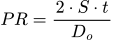
Barlow's Formula for Aluminum Pipe
Barlow's formula calculates the maximum internal pressure a cylindrical pipe can withstand based on its wall thickness, outside diameter, and the allowable stress of the material. For aluminum pipe the typical allowable stress is 7,500 psi.
PR = 2 × S × t / Dₒ
How It Works
Barlow's formula calculates the maximum internal pressure a cylindrical pipe can withstand based on its wall thickness, outside diameter, and the allowable stress of the material. For aluminum pipe the typical allowable stress is 7,500 psi. You can rearrange the formula to solve for any of the four variables.
Example Problem
An aluminum pipe has an outside diameter of 6 in and a wall thickness of 0.25 in. Using S = 7,500 psi, what is the pressure rating?
- Identify the known values: allowable stress S = 7,500 psi, wall thickness t = 0.25 in, outside diameter Do = 6 in.
- We need to find the pressure rating (PR) using Barlow's formula: PR = 2 × S × t / Do.
- Substitute the values: PR = 2 × 7,500 × 0.25 / 6.
- Multiply the numerator: 2 × 7,500 × 0.25 = 3,750.
- Divide by the outside diameter: 3,750 / 6 = 625.
- The pressure rating is 625 psi, meaning the pipe can safely operate at up to 625 psi internal pressure.
When to Use Each Variable
- Solve for Pressure Rating — when you know the pipe dimensions and material stress to find the maximum safe operating pressure, e.g., specifying an irrigation mainline.
- Solve for Allowable Stress — when you know the operating pressure and pipe geometry and need to verify the required material strength, e.g., selecting an aluminum alloy grade.
- Solve for Wall Thickness — when you know the target pressure, material, and diameter and need the minimum wall, e.g., designing a lightweight portable pipeline.
- Solve for Outside Diameter — when you know the pressure, material stress, and wall thickness and need the maximum pipe size, e.g., sizing a pipe run under a pressure constraint.
Key Concepts
Barlow's formula relates internal pressure capacity to wall thickness, outside diameter, and allowable stress. Pressure rating is directly proportional to wall thickness and allowable stress, and inversely proportional to outside diameter. The formula assumes thin-wall conditions where the wall thickness is small relative to the diameter, which is typical for aluminum pipe used in irrigation and industrial applications.
Applications
- Agricultural irrigation: sizing aluminum mainlines and laterals for center-pivot systems
- Marine piping: selecting corrosion-resistant aluminum pipe for seawater cooling systems on vessels
- Portable industrial piping: designing temporary transfer lines for mining and construction dewatering
- Process piping: specifying aluminum pipe for chemical plants where corrosion resistance and weight savings matter
Common Mistakes
- Using inside diameter instead of outside diameter — Barlow's formula specifically requires the outside diameter; using ID overestimates the pressure rating
- Ignoring safety factors — the allowable stress already includes a safety margin, but system design should also account for surge pressure, thermal expansion, and aging
- Applying steel allowable stress values to aluminum pipe — aluminum's allowable stress (typically 7,500 psi) is much lower than steel; using steel values dangerously overestimates pressure capacity
Frequently Asked Questions
How do you determine the wall thickness needed for an aluminum pipe?
Rearrange Barlow's formula to t = PR × Do / (2 × S). Enter your required pressure rating, the pipe's outside diameter, and the aluminum alloy's allowable stress. The result is the minimum wall thickness needed to safely contain that pressure.
What pressure rating does Schedule 40 aluminum pipe have?
Schedule 40 is a wall thickness designation, not a pressure rating. The actual pressure rating depends on the pipe diameter and alloy. For example, a 4-inch Schedule 40 aluminum pipe (t = 0.237 in, Do = 4.5 in) with S = 7,500 psi has a pressure rating of about 1,580 psi using Barlow's formula.
What is the allowable stress for aluminum pipe?
Under most conditions S = 7,500 psi is used for aluminum irrigation and process piping. Higher-alloy aluminum (6061-T6, 6063-T6) may have different values specified by the manufacturer or applicable code.
How does wall thickness affect pressure rating?
Pressure rating is directly proportional to wall thickness. Doubling the wall thickness doubles the allowable pressure, assuming the same outside diameter and material.
When should I use aluminum pipe instead of steel?
Aluminum is preferred when corrosion resistance and light weight matter, such as in agricultural irrigation, portable piping, and marine applications. Steel is stronger per unit cost and better for high-pressure industrial use.
Does Barlow's formula account for corrosion in aluminum pipe?
No. Barlow's formula uses the nominal wall thickness. Although aluminum resists atmospheric corrosion better than steel, acidic or alkaline environments can thin the wall over time. Engineers typically add a corrosion allowance or derate the wall thickness before applying the formula.
Is Barlow's formula accurate for thick-walled aluminum pipe?
Barlow's formula assumes thin-wall conditions, meaning the wall thickness is small compared to the diameter (generally t < 10% of Do). For thick-walled pipe, use the Lamé equation instead, which accounts for the radial stress gradient through the wall.
Reference:
National Resources Conservation Service. National Engineering Handbook. 1995. United States Department of Agriculture.
Aluminum Pipe Pressure Formula
Barlow's formula relates the internal pressure capacity of a thin-walled pipe to its geometry and material strength:
PR = 2 × S × t / Dₒ
Where:
- PR — pressure rating, the maximum safe internal pressure
- S — allowable stress of the pipe material (typically 7,500 psi for aluminum)
- t — wall thickness of the pipe
- Dₒ — outside diameter of the pipe
The formula assumes thin-wall conditions (t < 10% of Dₒ) and uniform hoop stress. It applies to any material — just change S. For aluminum, S is much lower than steel, so pressure ratings are correspondingly lower for the same geometry.
Worked Examples
Compressed Air
What pressure can a shop air pipe safely handle?
A machine shop installs 4-inch aluminum pipe (Do = 4.5 in, t = 0.237 in) for a 125 psi compressed air system. Using S = 7,500 psi, verify the pipe is adequate.
- PR = 2 × 7,500 × 0.237 / 4.5
- PR = 3,555 / 4.5
PR = 790 psi
The 790 psi rating far exceeds the 125 psi system pressure, confirming the pipe is safe. Real systems also account for surge pressure from compressor cycling.
Marine Engineering
What wall thickness do saltwater cooling lines need?
A vessel uses 6-inch aluminum pipe (Do = 6.625 in) for seawater cooling at 50 psi. With S = 7,500 psi, find the minimum wall thickness.
- t = PR × Do / (2 × S)
- t = 50 × 6.625 / (2 × 7,500)
- t = 331.25 / 15,000
t = 0.022 in
The theoretical minimum is only 0.022 in, but marine pipe must also resist corrosion, vibration, and handling loads — practical wall thickness is much greater.
Aerospace Engineering
What is the burst margin for lightweight hydraulic tubing?
An aircraft uses 1-inch 6061-T6 aluminum tubing (Do = 1.0 in, t = 0.065 in) for a 3,000 psi hydraulic system. With S = 12,000 psi (aerospace grade), check the margin.
- PR = 2 × 12,000 × 0.065 / 1.0
- PR = 1,560 / 1.0
PR = 1,560 psi
At 1,560 psi the tube is below the 3,000 psi requirement — a thicker wall or smaller diameter is needed. Aerospace hydraulic tubing typically uses drawn seamless tube with tighter tolerances.
National Resources Conservation Service. National Engineering Handbook. 1995. United States Department of Agriculture.
Related Calculators
- Steel Pipe Design Calculator — Barlow's formula for steel pipe
- Plastic Pipe Design Calculator — pressure class equations for plastic pipe
- Ductile Iron Pipe Calculator — wall thickness and pressure for ductile iron
- Pipe Hydrostatic Pressure Calculator — external water pressure on buried pipes
- Pressure Converter — convert between psi, kPa, bar, and other pressure units
Related Sites
- Dollars Per Hour — Weekly paycheck calculator with overtime
- Compare 2 Loans — Side-by-side loan comparison calculator
- Medical Equations — Hemodynamic, pulmonary, and dosing calculators
- InfantChart — Baby and child growth percentile charts
- Temperature Tool — Temperature unit converter
- LoanChop — Loan prepayment calculator