Constant Acceleration Motion Calculator
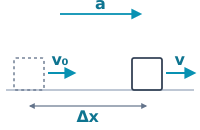
Final velocity equals initial velocity plus acceleration times time
The fundamental kinematic equation relating final velocity to initial velocity, constant acceleration, and elapsed time.
v = v₀ + a × t
Under constant acceleration, the average velocity is the mean of the initial and final velocities.
v_avg = (v₀ + v) / 2
Displacement equals average velocity multiplied by time under constant acceleration.
Δx = v_avg × t
The constant-acceleration kinematics equations describe motion in a straight line when acceleration does not change. The velocity equation v = v₀ + at gives the final speed, the average velocity equation v_avg = (v₀ + v)/2 gives the mean speed, and the displacement equation Δx = v_avg × t tells you how far the object travels.
A car starts from rest (v₀ = 0) and accelerates at 3 m/s² for 5 seconds.
The constant-acceleration kinematic equations describe straight-line motion when acceleration does not change over time. The three core relationships — v = v₀ + at, v_avg = (v₀ + v)/2, and Δx = v_avg × t — can be combined to solve for any unknown given three knowns. These equations form the foundation of classical mechanics and are valid only when acceleration is truly constant.
Constant acceleration means the velocity changes by the same amount each second. Free-fall near Earth’s surface (a = 9.81 m/s²) is the most common example.
Use Δx = v_avg · t. A car at 30 m/s decelerating at −6 m/s² stops in 5 s, with v_avg = 15 m/s and Δx = 15 × 5 = 75 m.
Yes. Negative acceleration (deceleration) means the object is slowing down in the positive direction. Always use a consistent sign convention for direction.
These equations only apply when acceleration is constant. If acceleration changes over time (e.g., a rocket burning fuel), you need calculus-based kinematics instead.
Substitute v = v₀ + a t into v_avg = (v₀ + v)/2 to get v_avg = v₀ + ½ a t. Then Δx = v_avg × t = v₀ t + ½ a t². It's the same physics expressed without t in the velocity term, useful when you know acceleration and time but not the final velocity.
Yes — v² = v₀² + 2 a Δx, sometimes called Torricelli's equation. Eliminate t between v = v₀ + a t and Δx = v₀ t + ½ a t² to derive it. It's the cleanest form when you know an object's start and end speeds plus the distance, and you want the acceleration directly.
Instantaneous velocity is the velocity at one specific moment — the slope of the position-vs-time curve. Average velocity is total displacement divided by total time. Under constant acceleration the two are linked by v_avg = (v₀ + v)/2; under varying acceleration they can differ substantially and you need calculus to relate them.
Air resistance violates the constant-acceleration assumption — drag force grows with v², so the object decelerates more strongly when moving fast and the velocity vs. time curve becomes nonlinear. For a feather or a parachute the kinematic equations fail almost immediately; for a dense compact object dropped from low height (a wrench, a baseball) the constant-a approximation stays accurate for a second or two before drag matters.
Reference:
Tipler, Paul A. 1995. Physics For Scientists and Engineers. Worth Publishers. 3rd ed.
Aerospace Engineering
A steam catapult on a Nimitz-class carrier accelerates an F/A-18 from rest at roughly a = 35 m/s² (about 3.6 g) over the deck stroke of about 2 seconds. What launch speed does the aircraft leave the bow at?
v = 70 m/s (~157 mph / 136 knots)
Real catapult exit speeds vary with aircraft weight, wind over deck, and steam pressure — 130 to 165 knots is the typical operating window. Modern electromagnetic launchers (EMALS on the Ford class) shape the acceleration profile to limit jerk on airframes and pilots.
Sports Science
An elite sprinter accelerates from a standing start (v₀ = 0) and reaches a top speed of v = 12 m/s after 4 seconds of running — close to the textbook "acceleration phase" duration of an Olympic-caliber 100 m race. What average acceleration does that imply?
a = 3 m/s² (≈ 0.31 g)
Real human sprint acceleration is not constant — peak acceleration of 7–10 m/s² happens in the first second, then drops sharply as drag and mechanical limits kick in. The 3 m/s² figure is a useful first-cut average for sprint design and pacing.
Civil Engineering
An express elevator accelerates uniformly from rest (v₀ = 0) up to a cruise speed of v = 4 m/s over 8 seconds of soft-start to keep passengers comfortable. Using v_avg = (v₀ + v)/2 = 2 m/s, what distance does the cab cover during this ramp-up?
Δx = 16 m (about 5 floors)
Elevator code limits passenger acceleration to about 1.0–1.5 m/s² for comfort. This 0.5 m/s² ramp is gentle by code but realistic — high-rise express cabs do the steepest ramp jurisdictions allow to maximize throughput.
Three core equations describe straight-line motion when acceleration is constant. Knowing any three variables lets you solve for the rest:
Where:
These equations are valid only when acceleration is truly constant (free-fall near Earth's surface, a car coasting under uniform thrust, objects on a frictionless inclined plane). When acceleration varies — rockets burning fuel, falling objects experiencing significant drag, vehicles with throttle changes — the kinematic formulas no longer apply and you need integration or numerical methods. Combining these three equations algebraically yields the familiar forms Δx = v₀ t + ½ a t² and v² = v₀² + 2 a Δx.
